Monday, July 31, 2006

KENYA'S SAITOTI ESCAPES CHARGES!


Saitoti has denied wrong doing in the Goldenberg affair. Kenyan former Vice-President George Saitoti should not be charged over the country's biggest financial scandal, the Kenyan High Court has ruled.
The court rejected the conclusions of an earlier commission of inquiry that recommended Mr Saitoti's prosecution over the so-called Goldenberg affair.
The $1bn scam in the 1990s involved government payments to a company for non-existent gold and diamond exports.
Mr Saitoti was serving at the time as finance minister and vice-president.
The court ruled that Mr Saitoti had been acting according to procedure when he approved a payment to the firm Goldenberg International.
The court also noted the attorney-general had cleared Mr Saitoti of wrongdoing in a statement that he issued in parliament more than a 10 ago.

"Today marks my happiest day in the last 16 years because during that period I have gone through much pain and suffering," Mr Saitoti said after the judgement.
Both Mr Saitoti and former President Daniel arap Moi, in whose administration he served, have denied any knowledge of the scam.
In February, Mr Saitoti resigned as education minister in the current administration, after being named in a report by a commission of inquiry into the Goldenberg affair.
The commission of inquiry led to the prosecution in March this year of six people - including a former intelligence chief and a former central bank governor - who are now bail.
The Goldenberg scandal is one of two huge corruption cases which has put President Mwai Kibaki under pressure to keep his 2002 election promises of fighting graft.

BBC NEWS REPORT.

THE CITY THAT GOT ITS SOUL BACK!

The city that got its soul back.
by Bryony Jones BBC News, Bath.

For almost 30 years, Bath has been a city without a soul. The city draws visitors from across the world, but the thermal springs on which Bath was founded have been off-limits since the 1970s, their mineral-enriched waters - and reputed 'healing powers' - wasted.

The rooftop pool boasts views across the city.Residents and tourists have been unable to do any more than taste the sulphurous liquid at the Roman Baths.
Those more used to the spa towns of continental Europe have been left perplexed at the lack of an opportunity to bathe in a city whose name is derived from that very pursuit.
"Bath would not exist were it not for the hot springs," said local councillor Nicole O'Flaherty, one of the spa's most vocal supporters.
"But for the past 20 or so years - for the first time in 1,200 years - the people of Bath have not been able to use their springs."
The thermal springs, which produce some 1.2 million litres of hot water every day, were closed off in 1978 amid fears over the safety of the water source after a woman died of Legionnaires' Disease.
The listed buildings which had housed the various spas fell into disrepair and the city built on its spring lost some of its purpose.
In the intervening years, five attempts were made to rejuvenate and reopen the thermal waters to the public, but each eventually failed, until the city hit upon the idea of doing so as a millennium project.
But as costs spiralled to £45m, three times over the original budget, and planned opening dates came and went, many residents of the city - whose council tax money was being used to fund the scheme - lost heart.
"The whole thing's been a bit of a catastrophe really," said local resident Christine Hawkins.
"It has really annoyed me that they have spent so much on it."

Staff have been busy with the final touches.

In pictures: spa unveiled

Squabbles between Bath and North East Somerset Council and builders Mowlem turned into full-blown rows, which went all the way to the High Court, delayed work even further.
But now the wait is over.

The pools have been filled, although the steam room smelled of turpentine rather than the delicate scent of lavender, jasmine and eucalyptus as the final work was being completed.
Contractors have been busy with the finishing touches, lifeguards have been trying out the rooftop pool and beauty therapists have been practising their reiki massage and hot stone therapy.

Charlotte Hanna, spokeswoman for the complex's operators, Thermae Bath Spa, said it was a very exciting time.
"We are really looking forward to welcoming our first customers and are just eager to get on with it."
And, for Nicole O'Flaherty at least, it has been worth the wait.
"It is like waking from a nightmare to see the finished building, how fantastic it is.
"In the middle of a World Heritage side, as well as restoring five listed buildings, we now have an unashamedly modern building, an iconic building."

What makes Bath's water so special:
Sulphate
Chloride
Calcium
Sodium Hydrogen Carbonate
Silicate
Spa's highs and lows

But Christine Hawkins said she had reservations that the building design was not the right choice.
"The building doesn't really go with Bath - the city is Roman or Georgian - this looks really out of place, it doesn't fit in.
"I don't know if it will really benefit us - I think it's more for the tourists.
"It's not something which appeals to me personally, but then I've lived here all my life and I've never been to the Roman Baths."
However Hotelier Matthew Stevenson said he was convinced: "Bath is a busy city anyway, it is very popular with people looking for short breaks, but the spa will mean we can really offer the complete package."

Visitor numbers to Bath, particularly from the US, have declined in recent years, and it is hoped the new spa will increase tourism.
Nicole O'Flaherty said: "Tourism is a very important factor in the city's economy - it brings in £400m a year... so it is vital to make sure tourists keep coming to the city."

Whether the spa will be top of tourists' must-see lists is unknown.
But it may take time to convince them to return, after a host of building problems and rows between the council and contractors saw the complex's opening date delayed time and time again.
Mr Stevenson, manager of the Abbey Hotel, said: "We've had people coming to stay with us for years, asking what time the spa opens, and we have had to say, 'Well, it will be a few years yet'."
"Being a spa town without a spa has been something of an issue, obviously."
The city will get its spa back on Monday, August 7, and while people may not be queuing around the corner to get in just yet, the spa has been inundated with bookings.
"I hope it will create a greater pride in what is already a very beautiful, special place," said Charlotte Hanna.
"I hope it will raise awareness of the importance of our heritage, because the thermal waters flowing under the streets of Bath are the lifeblood of the city."
Nicole O'Flaherty said: "We could have done no end of projects for the millennium."
"But this is simply perfect for Bath - it reconnects the city with its soul."

BBC NEWS REPORT.

ATHLETICS SORRY SAGA!

Athletics' sorry saga.
By Andrew Benson.

Even praying may not be much use to Gatlin now. The ramifications of Justin Gatlin failing a drugs test are extensive and serious for both the American and his sport.
The world and Olympic 100m champion - and joint holder of the world record - was found to have elevated levels of the hormone testosterone after a meeting in April, it has been revealed.
Both his primary and back-up samples have tested positive, meaning Gatlin now faces a fight to clear his name.
What is testosterone and what does it do?
Testosterone is a hormone that occurs naturally in both men and women, and can also be manufactured articificially and administered externally.
It helps build muscles, increasing speed, stamina and aggression and helping recovery.
It is listed with anabolic steroids on the World Anti-Doping Agency's list of prohibited substances.
A urine test measures its ratio with epitestosterone, a hormone produced along with testosterone but without its effects. The ratio in most people is 1:1. The ratio accepted in athletes' drugs tests is up to 4:1. Gatlin's levels have not yet been published.
What does it mean for Gatlin?
Gatlin, who denies knowingly taking drugs, is facing a lifetime ban from athletics unless he can prove the positive test came about through exceptional circumstances.

Gatlin had dominated athletics with his powerful sprinting. He would also almost certainly be stripped of the world record he shares with Jamaica's Asafa Powell. Gatlin equalled Powell's mark of 9.77secs in Doha in May, the month after his positive test.
Athletics operates a strict liability policy, which dictates that athletes are responsible for any substance found in their body.
A first offence would normally carry a ban of two years, but Gatlin failed a previous drugs test when he tested positive for amphetamines in 2001.
His suspension was lifted early after he persuaded athletics' governing body the IAAF that the test failure had been caused by medication he was taking.
But the IAAF made it clear at the time that he would be banned for life if he failed another drugs test, and it reiterated that stance on Sunday following the news of Gatlin's positive test.
How credible is the claim of Gatlin's coach that the sprinter was the victim of sabotage?
Athletics legend Michael Johnson has dismissed this suggestion by Trevor Graham as being "an old excuse" from a man with "no credibility".
Gatlin's lawyer Cameron Myler said Graham's comments were "not made with the knowledge or authorisation of either Justin or us", adding: "At this point we are trying to figure out what was the cause of the positive test."

Trevor Graham was a controversial choice of coach for Gatlin. Gatlin is the latest in a series of athletes trained by Graham to find themselves mired in a doping scandal.
Graham has worked with six other world champions who have tested positive - the shot putter CJ Hunter, 400m runners Alvin Harrison, Calvin Harrison, Antonio Pettigrew and Jerome Young, and the 200m athlete Michelle Collins.
He also coached former 100m world record holder Tim Montgomery, who despite never failing a drugs test was banned as part of the doping scandal arising from the California-based nutritional supplement company Balco.
Graham is a central figure in the Balco scandal. He was the whistle-blower who started it by supplying the authorities with a syringe containing the newly-created steroid tetrahydrogestrinone (THG).
Will Gatlin actually be banned?
Governing body US Athletics has come under fire in the past from world anti-doping chief Dick Pound for not doing enough to fight doping in the country.
But there has been a series of high-profile doping bans in America in recent years, so Gatlin's chances of escaping punishment do not look good.
Is testosterone easy to detect?
An effective test for elevated testosterone levels has existed for many years. There are complications arising from the fact that it is naturally produced in the body, so drug testers have to be satisfied the levels were not natural.
Doping is still a huge problem for athletics.
Michael JohnsonWorld record holder for 200m and 400mIn Gatlin's case, it has been established that the testosterone found in his body was administered artificially.
Gatlin tested positive for "testosterone or its precursors", which means that the substance responsible for the positive test may have been artificial - testosterone precursors can be found in sports supplements.
Athletes have been warned about these supplements because the industry is not fully regulated and they may be contaminated with prohibited substances.
What happens next?
Gatlin faces a hearing before the US Anti-Doping Agency, possibly early next week.
If he is banned, as seems likely, he will probably appeal, and the saga could rumble on for months or even years.
How big a blow is this for athletics?

With the world title added to Olympic gold, Gatlin had the world at his feetMichael Johnson, holder of the 200m and 400m world records despite retiring in 2000, says "doping is still a huge problem for athletics".
Just as cycling finds its reputation in the gutter following Tour de France winner Floyd Landis testing positive for testosterone, so it is with Gatlin and athletics.
His rivalry with Powell was the sport's most compelling storyline, and was building towards one of the most eagerly-anticipated showdowns in years. Now that race will probably never happen.
The men who run the 100m are the standard-bearers for the sport. It is the event with the biggest and most straightforward public appeal - it establishes who is the fastest human being on the planet, a hugely evocative concept.
It is hard to think of anything more damaging than the man who jointly holds that title - and who is also the reigning champion in the sport's two most high-profile championships - being exposed as a drugs cheat.
Even if Gatlin eventually clears his name, his reputation, as Johnson has said, will forever be tarnished.
And coming on the heels of the exposure of a number of other world-famous names, this is a revelation from which the sport's reputation will take a long time to recover.

BBC SPORTS NEWS REPORT.

Sunday, July 30, 2006

BACK TO SCHOOL ...IN CHINA!

Back to school... in China
By Carrie Gracie BBC News, China.

The BBC's former Beijing correspondent, whose husband is Chinese, follows her children's progress as they spend a term in a Beijing primary school.

Exercise is an important part of the learning process in Chinese schools. Teacher Song is built like a battleship. On the first day of term, she looked down from a great height, held out two broad brown hands and swept my children down the school corridor.
"Lai xiao pengyou! Come little friends!"
The little friends were pale with anxiety and sleep deprivation. Rachel, aged nine, had been first to wake in fear in the middle of the night before:
"I'm afraid I'll have no friends and I'll do something silly and everyone will laugh at me."
Seven year old Daniel was not far behind: "Mummy, I'm having bad thoughts!"
The bad thoughts turned out to be a dream in which a squirrel fell out of a tree and tumbled towards the water's edge. In the water was something unseen but threatening.
Daniel looked like that squirrel now rolling towards the unknown.
But I knew my job was to look calm and encouraging.
Morning school sounds surged in through the window. Not the hymns Rachel and Daniel sing in their catholic primary in south west London, but the Chinese national anthem, every child in the school saluting as the red flag snapped its way up the flagpole.
Memories
The scene took me back to all the other schools I have visited in China over the years. The same green tracksuits, the same flag, the same physical exercises...yi, er, san... one, two, three.
For Rachel and Daniel, three months in a Chinese primary school never got as traumatic as their dad's experience of 40 years ago From frozen north to tropical south, from rich seaboard to drought cursed hinterland, tens of millions of children all moving as one.
Watching that formidable regimentation is one kind of experience when you are a reporter and quite another when you are committing your own children to it.
"And every pupil must bring their own toilet paper." The deputy head was coming to the end of her lecture for new parents as we arrived at the door of the class.
The daughter I know as Rachel Gracie Cheng was introducing herself as "Cheng Rui".
Rui, auspicious, happy.
Daniel followed.
"Cheng Dan." Bright red. China's favourite colour of celebration.
Surrounded by strangers, they were not quite living up to their names. But when the 25 pairs of brown eyes turned to stare at Jin and me in the doorway, they broke into smiles and waves. Perhaps it was not going to be so bad after all.
Cultural Revolution
Rachel's nightmare did come to pass on day two though.
She had to stand up and admit that she could not understand the question she was being asked let alone answer it.

Tiananmen Square holds many memories of the RevolutionRachel and Daniel speak domestic Chinese at home in London, a vocabulary confined to food, sport and cartoons. The text about a great classical Chinese calligrapher was way above her head.
"The other children laughed behind their hands," she wept that afternoon when she got home.
When we had dried the tears, I told her the true story of her dad, Jin, aged eight.
The Cultural Revolution had just begun. Chairman Mao was worshipped as a jealous god. Jin's grandfathers had both been imprisoned because they had suspect foreign connections and too much education.
His grandmothers were beaten and his parents sent to the countryside to be re-educated. A story just like millions of others. But Jin made matters worse for himself by suggesting that as everyone could make mistakes, Chairman Mao might make mistakes too.
He was paraded in front of the school with the head teacher explaining that only a child from a very bad family background could make such wicked comments.
I explained to Rachel that her dad had chosen not to feel humiliated, that even at eight, life had become so surreal, so paradoxical it had forced him to separate his own judgment of himself from that of the world around him.
I did not tell her that her great grandmother had beaten Jin when he got home for bringing more shame on the family. But the story was already compelling enough to stop her crying. And when we caught up with Jin later, he had a practical suggestion.
If it happens again, you turn to your class and you say: "Little friends, if I spoke perfect Chinese I would not need to come all the way from London to learn. I hope you'll all help correct me when I make mistakes rather than laugh at me."
Exotic pets
For Rachel and Daniel, three months in a Chinese primary school never got as traumatic as their dad's experience of 40 years ago.
They stopped being treated like exotic pets and got told off themselves In fact it never got any worse than Rachel's moment of shame.
Now they both write Chinese characters and chant Tang dynasty poems. They have won red scarves and red stars for effort.
They got used to seeing teacher Song throwing books at their classmates. And they stopped being treated like exotic pets and got told off themselves. They learned to expect an uplifting moral at the end of every lesson. By the end of term, they belonged.
In fact the only grumble Rachel and Daniel have about school in China is the very same as the grumble they have about school in London.
And that is not enough to do at playtime.
Safety worries mean no climbing frames, and in the Beijing school no football even.
And what is the point of being seven and nine, after all, if you cannot hang upside down on the monkey bars or kick a ball around with friends?

From Our Own Correspondent was broadcast on Saturday, 29 July, 2006 at 1130 BST on BBC Radio 4. Please check the programme schedules for World Service transmission times.

BBC NEWS REPORT.

THE ARTS GO ON SHOW IN EDINBURGH!

The arts go on show in Edinburgh.
By Charles Pamment BBC News.

Each August the population of Edinburgh swells as thousands of visitors take in a wealth of theatre, comedy, music, art and film in the Scottish capital.
Commonly referred to as "the Edinburgh festival", the annual celebration of the arts incorporates several different festivals.
Six of the key figures preview their programmes for this summer, and explain how their festivals have evolved.

ART FESTIVAL
One of the newest festivals, highlighting the visual arts

BOOK FESTIVAL
Audiences with award-winning poets, authors and writers

FESTIVAL FRINGE
An array of comedy, theatre and music

FILM FESTIVAL
New and classic movies, championing independent cinema

INTERNATIONAL FESTIVAL
The best in classical music, ballet, theatre and opera

JAZZ AND BLUES FESTIVAL
With musicians from around the world

BBC NEWS REPORT.

IRAN'S ROLE IN CRISIS STILL MURKY!

Iran's role in crisis still murky.
By Mohammad Tabaar BBC World Service, Washington

Israel has deployed overwhelming force against Hezbollah. Since the conflict between Israel and Hezbollah erupted nearly two weeks ago, many pundits and US officials have blamed Iran for the crisis.
From the New York Times and Washington Post to Haaretz in Israel, commentators have warned of an Iranian trap to provoke Israel and the United States.
An American TV commentator called Iran "the spookiest country" and claimed that Iran "orchestrated the whole thing" in order to put pressure on the G8 summit and divert attention from Tehran's nuclear program.
But is it really an Iranian trap?
Anthony Cordesman, a senior analyst at the Centre for Strategic and International Studies in Washington, said the situation was not that clear-cut.
Whenever we have tensions with Iran over an issue like Iraq or nuclear weapons, people tend to end up with very clear, decisive conspiracy theories," he said.
And, indeed, he argued Iran has been trying to exploit any opportunity against Israel.
However, he added, it was simply unrealistic to think "that Iran somehow controls Hezbollah, that Syria doesn't need to be considered, that Hezbollah has no decision-making authority or capability on its own".
Careful balance
For the past two weeks, Iranian leaders have trod a fine line, continuing to support Hezbollah strongly, yet also indicating that they are not seeking a direct military confrontation with Israel.
In a recent statement, President Mahmoud Ahmadinejad said that Israel had "pushed the button of its own destruction" by attacking Lebanon.

Iran's official statements tread a cautious lineHe has also warned that if Israel attacks Syria it will face "a staunch response" from the Muslim world.
Nevertheless, the chairman of Iran's military joint chiefs of staff, Maj Gen Sayyed Hassan Firuzabadi, said on Saturday that Iran would "never militarily" join the current Middle East fighting.
Israel's use of overwhelming force against targets in Lebanon during this conflict has led some experts to argue that the crisis was not set in motion by Iran but is, rather, a pre-emptive trap by Israel to ensnare Iran.
Trita Parsi, a Middle East specialist at the Johns Hopkins University, said that following the collapse of the Soviet Union and the overthrow of Saddam Hussein, Israel sees Iran as its main strategic rival in the Middle East and is looking for an excuse to weaken its new geo-political enemy.
"Israel knows that it is now much stronger than Iran, but the current balance [of power] between Iran and Israel will probably shift in Iran's favour" if Tehran achieves nuclear capability - not even necessarily nuclear weapons - within the next few years, he said.
Mr Parsi contends that the current conflict could be seen as Israel's pre-emptive strike against Iran: "From Iran's perspective, it is better to confront Israel in the future. But from Israel's point of view, this can be seen as pre-emption."
Simple miscalculation?
Geoffrey Kemp, an international security expert at the Nixon Center, agreed that the Middle East balance of power played a role in the conflict, but said there were also larger issues involved.

Hezbollah's leader may not have expected such a response"I certainly believe that that's one item on Israel's agenda, but it is not the primary item," he said of the balance of power, but added that there was a more immediate objective for Israel.
"The real Israeli agenda is to defeat Hezbollah to the point where the Lebanese government can exercise control over its border."
That would weaken both Iran and Syria, he said.
"My view is that Hezbollah miscalculated. I do not believe that Sheikh Nasrallah had any idea the Israeli response would be as ferocious and intense as it has been."
But whether this latest conflict is an Iranian trap, Israeli pre-emption, or simply Hezbollah's miscalculation, there is one thing that is clear: The one who instigated this crisis is not necessarily the one who can control it - or put an end to it.
BBC NEWS REPORT.

FORMER SETTLERS RETURN TO ALGERIA!


Former settlers return to Algeria
By John Laurenson BBC News, Algeria.

Some 30,000 former French settlers have returned to Algeria. The bitter war which ended with Algerian independence from France in 1962 is still blighting relations between the two countries 44 years later.
The Algerian president is boycotting September's summit of Francophone nations to press his demand for an apology for what he calls the "cultural genocide" his country suffered at the hands of French colonialists.
But an extraordinary reconciliation has been taking place. Former French settlers in Algeria are returning in their thousands to visit what many see as their home country.
Our correspondent joined a party of 130 former colonialists for their return to the eastern Algerian town of Bijaya, the port the French called Bougie.
Political baggage
Josiane, an imposing former schoolmistress with forearms like sandbags, came out of the terminal building into the white African sunshine and made a speech.
"This is where we come from! This land belongs to us all, it's all of ours! No-one can take that away from us! No-one!" she cried, breaking into tears.
A polite round of applause. A "Bravo Josiane". Everyone was a bit tired after the flight, not really up for this.
But as people carried on getting on the coaches, she started up again.
"We never should have left! We would have made Algeria the most beautiful country in Africa!"
From a round of applause to a ripple. What with the heat and everything, Josiane was getting a bit carried away.
Don't forget. They classed us as natives - inferior in our own country!
Abdelnaur
Colonial tourists, and their sometimes rather unusual items of political baggage, are returning - on package holidays to the past, to a time when they were young, and "Algerie" was "Francaise".
They are still only a fraction of the one million settlers who once lived in Algeria, but 30,000 have already come back since the Islamist insurgency died down three years ago.
Pierre, whose family was in Algeria for eight generations, is one of those people. He says he has been living like a hydroponic plant ever since - out of the soil. He wants to find his roots again and start his life anew.
Jocelyne is another, proud of her headmaster father who was so determined that his Algerian pupils should get good marks and good jobs. "And they did", she says, her eyes shining.
And Brigitte, whose mother cried every night when they arrived in France, was called a colonialist, an exploiter, though her father was a road mender and her mother a seamstress.
She felt so guilty about being a pied-noir ("black feet" - the name once given to French settlers in Algeria) she did not even admit it to her husband until years after they married.
"But here, people remember my family", she says. "They say we were good people. They say 'Welcome home!' Do you realise? 'Welcome home!'"
Cultural genocide
The mayor invites everyone to a grand Couscous Royal of reconciliation.
After sharing his national dish he tells me he is enchanted by his meeting his former townspeople.
They are very welcome and he hopes they will return often. And if anyone wants to invest, they are very welcome to.

There is a pro-French sentiment in the town.
The mayor is not one of your slick, modern politicians.
He is a meat importer by trade and his communications advisor fidgets nervously every time he opens his mouth.
But he is a loyal member of the FLN, the party that drove the French out of Algeria and has held power ever since.
I ask if it is not contradictory for his country to welcome the pied-noirs as long-lost sons when Algiers has just said French colonisation was "cultural genocide".
He thinks about it a bit then says he follows his president's line and agrees with what his president says.
"But not in a nasty way", he adds with a winning smile, "in a nice way".
Bad memories
In town, I walk past a huge statue of a fearsome National Liberation Army mujahideen.
Some 300,000 people lost their lives in the war, 90% of them Algerian.
Pro-independence fighters bombed, assassinated and massacred pied-noir civilians as well as soldiers; the French army tortured and summarily executed suspects.

Anne-Marie managed to find her old flat.
Abdelnaur says he would not want to prevent the pied-noirs coming back but: "Don't forget. They classed us as natives - inferior in our own country!"
Mourad agrees they bring back bad memories. "Of abuses?" "Yes."
What is he thinking of? He won't say. I press him. He cries. I let it go.
Anne-Marie wants to find the apartment her family had to abandon when they left.
We walk past a shoe-shop still called Le Chat Botté (Puss In Boots) and the Church of Saint Theresa that has since become a mosque.
A local asks her what she thinks of how her town has changed. "For the better, of course, for the better!"
He says nothing has changed for the better. Nothing at all. They are all smiles. I don't think either is saying what they really think. But these are the soothing lies of peace.
Bound together
Up three flights of stairs she rings her old doorbell.
A man answers. His wife and her sister are there too, and everyone is kissing everyone on the cheeks.
And "of course we can come in" and "please excuse the mess".
Anne-Marie is invited to look round. The old bed. The old mirror. Out on the balcony she admires the view then points to the steps below.
"A surgeon we knew was assassinated here. His body was right there."
Inside, the master of the house says it is time to turn the page.
Despite everything that happened, Algeria and France are still bound together.
Algeria has inherited from French civilisation and is still economically dependent on France and the Algerian immigrants living there. Everybody agrees. We drink our orange squash. It is time to go.
From Our Own Correspondent was broadcast on Saturday, 29 July, 2006 at 1130 BST on BBC Radio 4. Please check the programme schedules for World Service transmission times.
BBC NEWS REPORT.

CRACKS EMERGE IN DARFUR PEACE DEAL!

Cracks emerge in Darfur peace deal.
By Jonah Fisher BBC News, Sudan.

This week President Bush met Minni Minnawi, one of the rebel leaders from Darfur in western Sudan. Mr Minnawi is the only rebel leader there who has signed up to a peace deal, but there are fears that this has made matters worse in the region. President Bush urged Mr Minnawi to build support for peace.

As the sun beats down on Darfur's dry flat desert, the order goes out from a leader to his men: "Solve lora infernis, unleash hell! We will not tolerate this any more."
These men are not the Janjaweed - the feared militia backed by the Khartoum government and responsible for the worst atrocities of this war. A hundred thousand people have died and two million have been displaced.
They are not the Darfur rebels either - a sprawling mess of armed groups who have targeted aid workers and food convoys.
No, this is the African Union (AU) - the organisation sent to bring peace to Sudan's far west.
Barking out the orders is a man who would not be out of place in a Hollywood film - South African sector commander Richard Lourens.
A veteran of wars in Angola and Namibia, he is not a man who takes failure well.
Sporting a closely trimmed black beard and a macho swagger, he has been in Darfur just a few months but he has had enough of being pushed around in this messy conflict.
Large parts of the surrounding desert are off limits to his patrols and twice in the past two weeks Colonel Lourens' men have suffered the ultimate military humiliation.
Stopped by rebels on a road, the South African soldiers handed over their weapons and vehicles without a shot being fired. Some 45 machine guns and four vehicles were taken.
Traumatised population
As Colonel Lourens reads the riot act, the man at the centre of Darfur's confusion is being acclaimed in Washington as a peacemaker.
For Minni Minnawi, a photo opportunity with President Bush is his reward for bowing to international pressure and signing an African Union-sponsored peace agreement with the Sudanese government.
The problem is that Mr Minnawi's signature has made the situation in Darfur worse, not better.

SLA forces are dividing along tribal lines
A former primary school teacher, Mr Minnawi leads his own faction of the Sudan Liberation Army (SLA) - the only rebel group in Darfur to have agreed terms with the Khartoum government.
But the deal has done little for the region's traumatised population and new rebel alliances spring up every few days.
The one positive note is that fighting has now stopped between Mr Minnawi's rebel faction and the Sudanese government.
But with both hands now free he has been able to devote his full attention to what had previously only been a side issue - attacking rival rebel leaders and their supporters.
In one of the African Union camps I spoke to a West African commander. He loaded a detailed map on to his laptop.
"This town is Korma," he said.
Korma and the surrounding villages are dominated by a tribe loyal to SLM Wahid, a rebel group which is opposed to Mr Minnawi and outside the peace agreement.
Taking me through events in meticulous detail, the commander explained how Mr Minnawi's rebels spent the first few days of July clearing villages of people en route to capturing Korma.
At least 80 people had been killed, he said, 18,000 fled for their lives.
"This was ethnic cleansing," he told me. Remaining villagers were being shot on sight, and he said he had seen pictures of two mass graves.
'Part of the problem'
Mr Minnawi's violence has left the African Union humiliated and deeply compromised. When the deal was signed the AU had welcomed him with open arms.
The rebel leader stays inside AU headquarters, eats AU food and his men drive, and on some occasions crash, AU cars. Atrocities have been brushed under the carpet and when Mr Minnawi wants to go into the field, an African Union helicopter is made available to fly him there.

Who are Darfur's rebels?

The men of the African Union went to Darfur to help protect its displaced people. Now they are seen as part of the problem: on the side of the Sudanese government and of Minni Minnawi. They are not welcome in many of the camps they are supposed to be protecting and despite the best efforts of people like Colonel Lourens, their men are demoralised.
Western donors have seen enough.
They want the AU's troubled mission to be replaced by a United Nations force.
President Bush apparently made his support for this proposal clear to Mr Minnawi when the two men met at the White House on Tuesday. But the Sudanese government firmly opposes it. A holy war will greet any western invading force, Sudan's President Omar al-Bashir has declared.
So now it seems the AU will stay here in Darfur at least until the end of the year.
A donor conference was held so they could ask for funds to beef up their operations and try to implement fully the peace deal.
The response was lukewarm. They were given only half the money they needed - just enough to continue stumbling along their current path.
Having pushed a partial peace deal onto Darfur the world seems to be walking away from a mess it helped to create.
Out in the desert again, Colonel Laurens is speaking to his men.
"Enough is enough," he shouts.
"We came here to be friends with our African brothers, but that's over. If they raise their weapons at you again - kill them."

BBC NEWS REPORT.

From Our Own Correspondent was broadcast on Saturday, 29 July, 2006 at 1130 BST on BBC Radio 4.
Please check the programme schedules for World Service transmission times.

Saturday, July 29, 2006

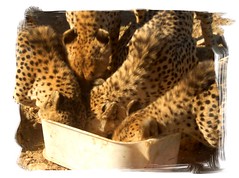
Feeding time!


My creation
Originally uploaded by Mara 1.

Namibia Cheetah ~Research~Namibia has the largest concentration of Cheetahs in Africa.

But the actual numbers are not so certain, and research is going on to find out if the numbers are on the decline, which is probable, or on the increase. Maybe the numbers have remained static.I was told that should the numbers have increased, then the Government would increase the number of Hunting Permits allowed on this magnificant Cat, so that Tourists - Hunters (Sic) would be permitted to shoot more of them per year.

LIVING UNDER THE PAPARAZZI'S GAZE!

Living under the paparazzi's gaze
By Kevin Young Entertainment reporter, BBC News.

Paparazzi are regular fixtures at premieres, seeking pictures of starsSinger George Michael has said he intends to sue two photographers for harassment after he was pictured searching for "no-strings" sex in a park in London.
He claimed in a BBC interview that he suspected two newspapers of paying the pair to follow him for "the best part of six months".
But is this level of attention something a celebrity should expect?
"It's not the norm, but it's happening more now than ever before", says Max Clifford.
He is perhaps the UK's best-known publicist, having spent his career setting up - and suppressing - stories involving figures in the public eye.
These days there were "more and more" paparazzi, he claimed, because "anybody who has access to a camera" could sell images to the press.

If you're craving it and always trying to get it, you can't complain if they're following you around - Publicist Max Clifford.
He says he felt sorry for the former Wham! singer because "he's far more sinned-against than sinner".
"It's been many, many years since he played the paparazzi PR game", Clifford says.
He has far more sympathy for George Michael than for the Beckhams because Victoria Beckham is "always using and working the publicity machine", he adds.
'It's a pain'
But while Michael says he "should not have to worry about who's watching me at 2.30 in the morning", actor Colin Farrell says he accepts the attention he receives as a celebrity.
"Yes, it's a pain, and have I ever wanted to punch a paparazzi? Sure. But the pros outweigh the cons," he told the BBC News website.
However, although some stars complain about being photographed illicitly, they are not necessarily blameless, according to one leading editor.
"Some celebrities are in on the game and are taking half the money for these paparazzi shots," claims Jane Ennis of British magazine Now.

Michael denied recent news stories had caused a rift with his partner"There are some celebrities who are in devils' deals because they know the shots will fetch a lot of money - so they're on holiday and they take their tops off.
"The paparazzi photographer takes the shots from some distance away and the two of them share the money."
Some celebrities do this to maintain their profiles, Ennis says, although she stresses this was not the case for Michael.
"Some of them haven't done anything of any talent or ability for years," she says.
"They're kept alive by behaving outrageously, getting photographed and those shots appearing in the papers."
Accidents
Moves have been taken to protect people in California from paparazzi who are felt to have overstepped the mark.
Photographers who commit assault while chasing celebrities face large fines under laws introduced by the state's governor - and former film star - Arnold Schwarzenegger.
In the past 18 months, there have been several accidents involving celebrities who were being followed by photographers.

The public are more interested in the reality of people's lives and the unofficial take on their lives
Jane Ennis, Now magazine
Actress Lindsay Lohan was cut and bruised after a photographer's van collided with her car, although he was cleared of any charges.
Lost in Translation star Scarlett Johansson had a minor crash while allegedly being followed by paparazzi.
Oscar-winner Reese Witherspoon claimed she was once chased by photographers who were trying to force her from the road.
And singer Britney Spears was reported as saying her fear of "reckless" paparazzi prevented her from taking her baby son out in public.
'Deeply saddened'
Perhaps the most famous case of all was the death of Diana, Princess of Wales in 1997.
Three photographers were convicted of breaching French privacy laws for taking pictures of her on the night she was killed in a car crash in Paris.
Earlier this month, Princes William and Harry said they were "deeply saddened" that Italian magazine Chi had printed a photo of their mother as she lay dying.
However, there seems little chance that demand for such "off-guard" photographs will decline.
"The public are more interested in the reality of people's lives and the unofficial take on their lives than they are in the stuff that celebrities and their publicists like to feed out," says Ennis, whose magazine sells almost 600,000 copies per week.
And Clifford added that stars who sought publicity could not protest about the paparazzi.
"If you're craving it and always trying to get it, you can't complain if they're following you around," he said.
BBC NEWS REPORT.

CATHY BUCKLE'S LETTTER FROM ZIMBABWE!

Dear Family and Friends,

Parliament re-opened on Tuesday this week but all attempts to watch the full event on state run TV were in vain. There was a power cut just a few minutes after the special repeat broadcast began and the night went dark and quiet - again. Those few brief minutes however had been more than enough to raise eyebrows. A number of "cultural reforms" have been undertaken by Zimbabwe's parliament which now resembles a safari lodge. A stuffed leopard and two antelope heads hang on the walls and a leopard skin adorns the ceremonial chair used by Mr Mugabe. Two enormous elephant tusks now frame the Presidential chair and it was between these two great teeth that Mr Mugabe stood to address the House. Near him sat Mrs Mugabe on a high backed green leather chair which had been carefully placed on a striking zebra skin. Hardly had these images registered and before the speech began, the electricity went off.

The images of our leaders sitting amongst elephants and kudu, zebra and leopard are particularly ironic now as the country plunges back in time and people ravage the environment in order to survive. Our lavishly decorated safari parliament is about as far away from the reality of life in Zimbabwe as you can possibly imagine.

Every morning the sound in urban and rural Zimbabwe is that of woodchopping. All day every day you see lines of women walking with bundles of great long tree branches balanced on their heads and men with hand carts and wheel barrows piled high with newly chopped indigenous wood. All day, every day and in every direction you see smoke. Some is from urban householders cooking outside on open fires. More is from incessant uncontrolled fires streaming across the horizon, consuming everything in their path. Seeing the massive amount of wood collecting and looking at horizons permanently smudged with smoke, you cannot help but wonder how Zimbabwe's wildlife can possibly survive this unrelenting attack on the environment. Grass for grazers is reduced to ash, leaves for browsers is burnt out and trees for shade, shelter and habitat are felled. Undoubtedly the abundance and variety of birds, reptiles, mammals and insects is under severe threat as the assault on our envirnoment continues unchecked.

The reality of life in Zimbabwe has been shocking in the last week. In my home area the electricity was cut for over 29 working hours during the week. The price of a loaf of bread shot up from one to two hundred thousand dollars overnight. The foreign currency rate soared on the blackmarket with one British Pound selling for one million Zimbabwe dollars.
Appreciating cultural reforms of elephant tusks and leopard skins is aworld away from bread we can't afford, bills we can't pay and hours and hours on end when we cannot work or conduct our business as the electricity is off. Reality in Zimbabwe draws ever further away. Until next week, thanks for reading, love cathy

29 July 2006 Copyright cathybuckle

http://africantears.netfirms.com My books "African Tears" and"Beyond Tears" are available from: orders@africabookcentre.com ; www.africabookcentre.com

FOUR AFRICANS DIE NEAR CANARIES.

The Africans risked a perilous crossing to reach Spain. Four Africans have been found dead in a small open boat packed with migrants, intercepted off the Canary Islands.
The Spanish authorities said the boat, carrying 26 other migrants, was escorted to a port on Tenerife.
Boats carrying almost 300 people have been intercepted off the Canary Islands in the past 24 hours, officials say.
The Spanish government says more than 11,000 Africans have made the perilous crossing to the Canaries this year - already double the total for 2005.
Spain and Malta are struggling to cope with an influx of migrants from Africa.
The European Union plans to launch maritime patrols around the Canaries and along the West African coast to help limit the flow of migrants.

BBC NEWS REPORT.

Friday, July 28, 2006

KABILA RALLY ENDS CONGO CAMPAIGN!

Kabila's Kinshasa rally will conclude his campaign. Thousands have gathered in Kinshasa, capital of the Democratic Republic of Congo, as President Joseph Kabila returns for a last election rally.
Campaigning is prohibited on Saturday, with voting to start on Sunday.
The elections will be DR Congo's first democratic polls in more than 40 years, and are the culmination of a process aimed at ending a long civil war.
Armed opposition supporters clashed with government security forces on Thursday, and reportedly on Friday. On Friday, crowds gathered at Kinshasa airport and lined the road into the city as Mr Kabila arrived and made his way towards the stadium.

DR CONGO POLLS
33 presidential candidates
9,707 parliamentary candidates
25.6m voters

Reporters' log
The mood was that of a visit by a head of state rather than by an election candidate, the BBC's Arnaud Zajtman reports.
Mr Kabila's arrival was more orderly, but also less well-attended, than was the case when opposition leader Jean-Pierre Bemba arrived in the city on Thursday.
Security forces, including anti-riot police and the presidential guard were deployed along the way, as Mr Kabila's route to the stadium took him through opposition stronghold districts, our correspondent says.
An official in the RCD, the party of presidential candidate Azarias Ruberwa, told the BBC that a soldier in Mr Ruberwa's entourage had been killed and two others wounded in a clash with Mr Kabila's security forces as the two groups met on the way to their respective rallies.
Correspondents say the incident, as well as Thursday's clash between Mr Bemba's troops and the police, highlights the problem of former rebel leaders who have now become presidential candidates still being able to muster their own troops.
An estimated 10,000 people have gathered at the stadium where Mr Kabila is due to speak, the BBC's Mark Doyle says.
There was also lively campaigning in the southern city of Lubumbashi on Friday, with party supporters carrying placards and playing Congolese dance music through loudspeakers, the BBC's Joseph Winter reports.

At least four people were killed in Kinshasa on Thursday: two babies who died when Mr Bemba's bodyguards' compound was set alight, and two police who died in clashes with Mr Bemba's supporters.
UN envoy Ross Mountain expressed confidence that the polls would be a success.
He said that while Thursday's deaths were tragic, the Bemba rally had not sparked a major confrontation.
"The security forces played a proper, professional role," he told reporters in Kinshasa on Friday. "We were tested I think yesterday, and I believe the Congolese authorities and the Congolese leaders came through that test."
In the east of the country, the leader of South Africa's observer mission, Minister Mlueki George, has expressed concern that police had not yet received riot gear for crowd control nor motor vehicles in the volatile North Kivu province.
Over 25m voters are registered for the presidential and parliamentary vote.
The United Nations has about 17,000 soldiers - its biggest peacekeeping mission in the world - deployed to ensure order.
Before the violence in the capital, one of the last obstacles to Sunday's election was removed on Wednesday when the three main militia groups in the troubled eastern province of Ituri agreed to lay down arms.

BBC NEWS REPORT.

Thursday, July 27, 2006

S.A. RAMAPHOSA BACK IN THE LIMELIGHT!

South African media have leapt onto reports - later denied - that trade unionist turned businessman Cyril Ramaphosa was back in the running to lead the ANC and perhaps the country. South African writer William M Gumede examines where Mr Ramaphosa fits into the race to succeed Thabo Mbeki.
When South African business tycoon Cyril Ramaphosa steps out in public, he is often besieged by South Africans of all colours and political stripes - ANC supporters and opponents alike.

CYRIL RAMAPHOSA

Chairman of Shanduka Group
Market influence estimated $20bn
Major player in resources, energy, property, financial services
Leading black economic empowerment company
Shanduka Foundation has pledged $15m in social investment. Most of them have only one question: is he going to make himself available as a candidate for the presidency of the ANC next year, and, if he wins, the leadership of the country in 2009?
He usually brandishes his trademark warm laugh, and replies: "But I'm quite happy doing what I'm doing" - meaning business.

This week, he dismissed Sunday newspaper reports that he had put his name forward as a presidential successor.
But the possibility of a President Ramaphosa has been on the cards for as long as South Africa has been a democracy.
Shortly after Nelson Mandela became president in 1994, he recommended to the ANC inner circle that his presidential successor should be Cyril Ramaphosa.
The suggestion was declined. The group of former exiles who were then very powerful in the party were adamant that Mr Mandela's successor be drawn from among them.
They insisted on Thabo Mbeki, the heir named by former ANC leader-in-exile Oliver Tambo on his deathbed.

Ramaphosa was Nelson Mandela's first choice as successorMr Mandela then proposed constitutional amendments that would see Mr Ramaphosa - who cut his teeth in the domestic wing of the ANC - becoming the prime minister under an Mbeki presidency.
But Mr Mbeki and his supporters did not want a serious rival so close to the throne.
'I'll be back'
The result was that Mr Ramaphosa left politics for business, to the disappointment of Mr Mandela and his legions of supporters.
In parting, a visibly sad Nelson Mandela, said Mr Ramaphosa was still young (he is now 53) and could still succeed Mr Mbeki.
Mr Ramaphosa then promised he would be back in 10 years. Those 10 years have now passed.
Mr Ramaphosa was the ANC's chief negotiator during the constitutional negotiations with the National Party government that brought legal apartheid to an end.
He was also the architect of South Africa's constitution-making process.

Thabo Mbeki's presidential term ends in 2009He cut his teeth in the trade union movement, where he was general secretary of the biggest and richest trade union in Africa, the National Union of Mineworkers.
He has remained a member of the ANC's highest decision making body, its national executive committee.
In 2001, Mr Mbeki accused him and two other ANC grandees and Mbeki rivals, Tokyo Sexwale and Mathews Phosa, of plotting to oust him as president.
Following the fallout - and a subsequent apology from Mr Mbeki - Mr Ramaphosa and Mr Mbeki struck a secret pact.
Part of the pact, according to close associates of both men, was that Mr Mbeki would not stand in Mr Ramaphosa's way, if he decides to stand as a candidate to succeed the president.
Leadership style
The irony is that Mr Ramaphosa, despite his early bitter fallout with Mbeki over who should succeed Mr Mandela, shares the same economic and social policy views as Mr Mbeki, although he has a more inclusive, participatory and warmer leadership style.
Mr Ramaphosa has gone out of his way to endorse Mbeki's economic policies, although he has been critical of his unorthodox views on the causes of Aids and his quiet diplomatic approach to the problems in Zimbabwe.
However, Mr Ramaphosa's main obstacle will be to overcome negative perceptions that black economic empowerment, of which he is a major beneficiary, has only empowered a small elite who rarely plough their newly-found riches back into their communities.

Ramaphosa made his name as a trade union leaderHis insistence this week that he was not interested in the ANC presidency should not be taken as a definite "no".
Mr Mbeki said the same thing just before he became president.
And if you asked Jacob Zuma if he was interested in becoming president of the ANC, he would also say no - despite the fact that he is running a very public campaign for the position, backed by some powerful factions within the ANC and its allies.
Even current Deputy President Phumzile Mlambo-Ngcuka - Mr Mbeki's protégé and the woman he desperately wants to succeed him - says she is not interested in the top job.
To get ahead in the ANC, one does not openly state one's ambitions, but rather feigns humility.
Compromise candidate?
However, historically the ANC presidential election has usually only been decided at the conference itself, with Mr Mbeki's election being the main exception to the rule.
Mr Ramaphosa, as one of the ANC's most accomplished strategists, knows that.
It does appear that the "leak" to South African newspapers over the weekend about Mr Ramaphosa's entry into the presidential succession race, is likely to have come from his opponents, who want to draw him into the rough and tumble of the race sooner rather than later.

Zuma's divisive campaign tactics could backfireThis way, they hope that by the ANC's conference in December 2007, the glitter would have gone out of his campaign.
It appears that ANC members - even some of those who support Mr Zuma - increasingly accept that a Zuma presidency could tear the ANC apart, and potentially lead to the break-up of Africa's oldest liberation movement.
Something similar happened to Winnie Madikizela-Mandela in 1997: she was popular, but ANC grassroots members feared her ascendancy would cause even more division and she lost out.
Indeed, judging by the divisions already caused by Mr Zuma's presidential campaign, he is unlikely to be able to unite the ANC, let alone build confidence in South Africa, at the moment when the country has finally reached economic take-off.
Come the ANC's December 2007 conference, members will most likely want to opt for a compromise candidate, who has not been part of the acrimony, smears and mudslinging that have accompanied Mr Zuma's attempts to stake his claim.
Cyril Ramaphosa, as astute as he is, probably knows that.
William M Gumede is author of Thabo Mbeki and the Battle for the Soul of the ANC.

BBC NEWS REPORT.

UK SETS NEW DATE FOR E-WASTE LAW!

Electronic waste is the fastest growing form of rubbish in the EU. Producers and importers of electronic goods will become responsible for their recycling from July 2007, the UK government has announced.
Ministers said the introduction of the Waste Electrical and Electronic Equipment (WEEE) directive would ease the growing problem of e-waste.
The legislation was introduced in every EU nation last summer, apart from the UK and Malta.
The new date was confirmed at a launch of a consultation on the measures.
Speaking at the launch, Department of Trade and Industry (DTI) minister Malcolm Wicks said: "Electrical equipment is the fastest growing category of rubbish across the European Union, and the UK alone is now generating about one million tonnes of the stuff every year."
'Major difficulties'
The WEEE directive is intended to minimise the impacts of electrical and electronic devices on the environment during their life time and when they are thrown away.
Under its measures, producers will have to finance the treatment and recycling of equipment, and retailers will have an obligation to offer take-back services to consumers.
WEEE was originally planned to come into force in August last year, but the government delayed its implementation citing "major difficulties".
While many manufacturers had taken steps to make their products recyclable, problems surrounded the legacy of goods made or sold before 2005.
Mr Wicks said he hoped the confirmation of the July 2007 date would help those affected by the plans.
"In announcing full producer responsibility, I want to provide those businesses who have yet to take up their obligation with the certainty they need to plan for implementation," Mr Wicks added.
The Environment Agency, which will be responsible for overseeing the measures, welcomed the announcement.
The government have gone about implementing this directive in a thoroughly shambolic way
Alan Duncan, Conservative trade and industry spokesman
"The regulations will lead to less waste going to landfills and more materials being made available for recycling," said the agency's head of waste regulations, Liz Parkes.
"We have been preparing in anticipation of our role and have been gearing up to handle the registration of producers of WEEE in line with DTI proposals."
'Longest WEEE in history'
Peter Robinson from campaign group Waste Watch said it was good that a date was set for the much-delayed directive.
"We are pleased it is finally coming into force, and after all the delays it is better it is late rather than a bad piece of legislation."
The Conservative trade and industry spokesman, Alan Duncan was less complimentary, describing it as the "longest WEEE in history".
"After five consultations, a review and three years of delays the government is today launching yet another consultation on how best to put this directive into UK law," Mr Duncan said.
"The government have gone about implementing this directive in a thoroughly shambolic way."
The government's consultation on the key proposals will run until October, ahead of the measures becoming law in December, with full producer responsibility being introduced from 1 July 2007.

BBC NEWS REPORT.

HEAT ADVICE AS SCOTLAND SWELTERS!

The Meadows in Edinburgh was one area basking in the sunshine. Experts have issued safety advice as Scotland continues to swelter in the summer heatwave.
Temperatures nudged 30C this week, with Aberdeen experiencing its hottest day since records began.
Scotland's chief medical officer has advised people to drink plenty of water and stay out of the sun at the hottest times of the day.
The RNLI has warned people of the dangers of using inflatables in the water off Scotland's coast.
Colin Millar, of Troon lifeboat team, said: "We've rescued many children who have been swept out to sea due to the offshore winds.
"Lilos may be fun in the swimming pool but they are not safe on the sea.
Swimming pool
"If you see someone on a lilo being swept out to sea, don't go after them, ring 999 or 112 immediately."
Thousands of people flocked to the beach in Aberdeen on Monday as temperatures reached 29.8C.
More than 1,100 people visited the open air swimming pool in nearby Stonehaven, giving the attraction its busiest day for decades.
Mary Mitchell, the chairwoman of the Friends of the Pool, said: "It's a long time since I remember it being so busy, I'd have to go back to the 1970s I think."
The area was cooler on Tuesday, with temperatures falling to 19.5C.

Temperatures have been rising in the south of Scotland
However, the south and west of the country continued to see high temperatures.
Prestwick Airport reached 28C at noon, while there were figures of 26.9C at Threave in Dumfriesshire, 26C in Glasgow and 22C in Edinburgh.
With the hot spell set to continue, Chief Medical Officer Dr Harry Burns issued advice about being safe in the sun.
"The most important thing to remember in hot weather is to keep properly hydrated by drinking lots of water," he said.
"The public should be sun aware and should avoid sitting in direct sunshine between 1200 BST and 1500 BST, when the sun is at its hottest.
"You should stay cool by using fans or sitting in the shade and if you are going to be in the sun, you should use UVA protective lotions and wear a hat."

BBC NEWS REPORT.

LEADERS UNEASY OVER IRAQ'S FUTURE!

Leaders uneasy over Iraq's future.
By Jamie Coomarasamy BBC News, Washington

Both leaders seemed unsure about who should answer questions. Neither man talked about failure, nor were they likely to, but that was the subtext to the meeting between US President George W Bush and Iraqi Prime Minister Nouri Maliki.
The security operation in Baghdad, which the Iraqi leader launched six weeks ago - and which Mr Bush had endorsed during his unannounced visit to the Iraqi capital last month - has not produced results.
Or, more accurately, it has produced the wrong ones.
The upsurge in sectarian violence which has coincided with the crackdown, has seen the Iraqi civilian death toll rise to about 100 per day.
The US military estimates that there have been 40% more major attacks in Baghdad in July, than in previous months.
Ill-at-ease
It has all led a sombre-looking President Bush to approve what a White House official has called the "reshufflement" of American troops in Iraq; essentially, beefing up their numbers in Baghdad.
The scale and timing of the redeployment were not revealed during the White House news conference, although the president's national security advisor, Stephen Hadley, later gave some details of the new security plan, which he described as taking a "more neighbourhood-to-neighbourhood approach".
What the joint news conference did seem to do, though, was shed light on the president's state of mind and on his developing relationship with Mr Maliki, a Shia politician, who is - at once - Iraq's first democratically elected prime minister and - for some - America's last hope for achieving a stable democracy.

There have been an increasing number of attacks and killings
In Baghdad last month, it was Mr Bush, the guest, who seemed to be calling the shots.
His trip there was a political, diplomatic and security event, with his host apparently unaware of his arrival, until five minutes before the US president appeared on his doorstep.
On home territory, though, at a scheduled news conference, Mr Bush looked strangely ill-at-ease.
Although he was both welcoming and supportive of Mr Maliki, he was not his usual forceful self; often speaking away from the microphone, as if to betray a lack of confidence in the message.
'Terrible' violence
Whether or not this reflects a sense of pessimism in the White House, it is certainly consistent with the growing mood of realism that's been on display over the past few weeks.
You could hear that in the president's description of the violence in Baghdad as "terrible" and in the care he took to say that Mr al-Maliki had called for US troops to stay in the region.
There was none of the usual talk of American troops standing down as Iraqi troops stand up. In the current crisis, everyone is forced to stand together.
At least, that is true for Iraq. It would have been impossible to paper over the splits between the two leaders over Lebanon and, so, they didn't really try to.

Security plans to rein in the violence have failed so far.
President Bush stressed America's commitment to providing Lebanese civilians with humanitarian assistance, but he and his guest avoided answering such awkward questions as "What was Iraq's view of Hezbollah?"
It all made for a rather awkward occasion. At one point there was an almost comic back and forth between the two leaders over who should answer a question - not helped by the translator's delay.
And, even at the very end of the news conference, when the two men were walking away, there was another potentially embarrassing moment.
The Iraqi prime minister had only gone a few steps, when he spun around and strode back to the lectern. Was he so determined to have the last word, that he would make such an obvious breach of diplomatic protocol?
No. He had simply forgotten his notes.

BBC NEWS REPORT.

PRESIDENTS ESCAPE LIBERIA BLAZE!

Presidents escape Liberia blaze

The fire broke out during independence anniversary celebrations. A fire has broken out in Liberia's presidential offices as President Ellen Johnson-Sirleaf was about to host a gathering of visiting presidents.
Firefighters had managed to put out the blaze at the Executive Mansion by late Wednesday afternoon, the BBC's Jonathan Paye-Layleh reports from Monrovia.
The leaders of Ghana, Ivory Coast and Sierra Leone were there when the fire broke out, but escaped unharmed.
No injuries are reported but the blaze marred independence day celebrations.
Officials have not yet stated what caused the fire, which began on the fourth floor of the building, where the president's office is situated.
They say the incident will be investigated.
The blaze came just after the president switched on generator-powered street lights in the capital, Monrovia, which has lacked electricity for 15 years.
On Tuesday, piped water was made available in the capital for the first time in many years.
'Proud'
Mrs Johnson-Sirleaf had promised to bring electricity to the whole of Monrovia within six months of assuming office in January.
Ghana's President John Kufour joined her to switch on the street lights in Congo Town, an eastern suburb of Monrovia on Wednesday morning.

Liberia switches on street lights

Ghanaian technicians have helped install the street lights for the event, and the generators and poles came from Ghana.
"Ghana is proud to have been able to render this support to you and your nation," Mr Kufour said to Mrs Johnson-Sirleaf.
"As lights dispel darkness, so with the restoration of power to Liberia the period of gloom and darkness engendered by political turmoil must come to an end," he continued.
As Liberia celebrates 159 years of independence, every effort was being made to ensure visible signs that life in the capital is improving, our correspondent says.
In another landmark event, parts of the capital got access to pumped water for the first time in 15 years on Tuesday.
But after decades of misrule, Liberia's road network is still in ruins, an there is no national telephone network and no national electricity grid.
Mrs Johnson-Sirleaf won presidential elections last year that ended a brutal 14-year civil war and promised to rebuild the resource-rich country.
President Johnson-Sirleaf admitted that she had expected to do more by this stage, but contracts and plans already in place were difficult to change.
Low fee
Mrs Johnson-Sirleaf led an array of officials to the densely populated Fiamah community of Monrovia for the water supply launch late on Tuesday.

The water will supply greater Monrovia and the east of the city.
"I just want to say how proud we are. This was done by a full Liberian team," the president said.
She was told that 30% of the city's water needs had been addressed so far.
The water will flow from there to greater Monrovia and at least two large communities in the east of the capital.
The country's water treatment plant outside Monrovia was destroyed during the civil war that ended an 2003 when in interim government came into power.
Since then there has been serious renovation work on the main 36-inch pipe that supplied greater Monrovia before the war.

BBC NEWS REPORT.

FANS SAY GOODBYE TO TOP OF THE POPS!

Fans say goodbye to Top of the Pops
By Mark Savage BBC News entertainment reporter

Former Radio 1 DJ Dave Lee Travis was one of the presenters. As the audience queued to get into the final recording of Top of the Pops there was something of a buzz in the air.
Several people were dressed as their favourite pop stars, and Axl Rose rubbed shoulders with Nana Mouskouri for possibly the first and last time.
As the crowd entered the studio, decorated with logos from the past 42 years of the BBC pop programme, the excitement only grew.
The question of the evening: Which bands would be appearing?
The tickets promised "surprise guests" and excited fans speculated they might see Robbie Williams, McFly or even The Rolling Stones - closing the show in the same way they had opened it 42 years earlier.
In the end, they were to be disappointed.
The last ever Top of the Pops will be constructed from archive performances, and on Wednesday the producers were merely recording the links between those clips.
I haven't had so much fun since 1947!
Tony BlackburnHowever, the crowd seemed to take it in their stride, screaming for the cameras and singing along to a video of Sonny and Cher performing I Got You Babe.
There was also excitement at seeing an array of presenters from the programme's history.
Trading insults
Sir Jimmy Savile, Janice Long, Dave Lee Travis and Tony Blackburn were back on the Top of the Pops stage alongside more recent presenters such as Sarah Cawood and Reggie Yates.
The guest presenters helped to keep the audience in high spirits, exchanging banter with the crowd and trading insults with one another.

Fans dressed up as their favourite pop stars for the recordingAt times it felt like a Radio 1 roadshow, as Sir Jimmy asked all the single women in the room to raise their hands.
"I haven't had so much fun since 1947," exclaimed Tony Blackburn later in the recording.
Others were less enthusiastic. "My hair was black when we started this," remarked the greying Dave Lee Travis.
However, there was an air of nostalgia in the studio as classic moments from Top of the Pops history were played out on the studio's big screens.
"It was sort of a trip down memory lane," said Paul Cooksley, 34, who was in the audience for the 44th and final time.
"Watching some of the clips they were showing, I spotted some of the shows I'd been to in the past."
Shiny disco balls
Many of the elements that made Top of the Pops an institution in the 1970s were brought back for the programme's finale.
The whole atmosphere at the end was quite sad
Paul CooksleyTop of the Pops fanA gigantic glitter ball hung from the ceiling, dry ice flooded the stage, and Pan's People made a fleeting appearance.
The audience, as ever, pushed and shoved for a spot beside the presenters in the hope of being seen back home on television.
Those with deeley boppers, crazy wigs and short skirts got manoeuvred to the front by the show's ever-attentive floor managers.
After a marathon two-and-a-half hours, fireworks exploded and balloons dropped from the ceiling as the presenters read their final link.
"Perhaps we should say 'see you next week'," joked Mike Read.

Paul Deacon, 44, came dressed as Sir Jimmy Savile. But, as the studio lights went out, the carnival atmosphere gave way to a more sombre mood.
The hosts huddled together to wonder whether the show would ever come back, while the production team took photographs of each other on the set for the last time.
"The whole atmosphere at the end was quite sad, because everyone realised that that was it," said Mr Cooksley.
"It was obviously the end of an era and it was just really, really sad to have that brought to a close."
"In 20 years time we can say 'I was there'," said another audience member as they left the studio to the strains of Queen's We Are The Champions.
But it was the song playing in the BBC's audience foyer, Coldplay's The Scientist, that best summed up the evening.
"No-one said it was easy," sang Chris Martin.
"No-one ever said it would be this hard."

BBC NEWS REPORT.

Wednesday, July 26, 2006

LIBERIA SWITCHES ON STREET LIGHTS!


Liberia switches on street lights.
By Jonathan Paye-Layleh BBC News, Monrovia

The street lamps will be powered by generatorsLiberian leader Ellen Johnson-Sirleaf has switched on generator-powered street lights in the capital, which has been without electricity for 15 years. She had promised to bring electricity to the whole of Monrovia within six months of assuming office in January. "When I made this commitment... I was an outsider looking in," she said.

As Liberia celebrates 159 years of independence, every effort is being made to ensure visible signs that life in the capital is improving. On Tuesday, tapped water became available in the war-torn capital. But after decades of misrule, Liberia's road network is still in ruins, an there is no national telephone network and no national electricity grid.

Mrs Johnson-Sirleaf won presidential elections last year that ended a brutal 14-year civil war and promised to rebuild the resource-rich country. President Johnson-Sirleaf admitted that she had expected to do more by this stage, but contracts and plans already in place were difficult to change.

Ghana's President John Kufour joined her to switch on the street lights in Congo Town, an eastern suburb of Monrovia on Wednesday morning. Ghanaian technicians have helped install the street lights for the event, and the generators and poles came from Ghana. "Ghana is proud to have been able to render this support to you and your nation," Mr Kufour said to Mrs Johnson-Sirleaf. "As lights dispel darkness, so with the restoration of power to Liberia the period of gloom and darkness engendered by political turmoil must come to an end," he continued.
In another landmark event, parts of the capital got access to pumped water for the first time in 15 years on Wednesday. The water will supply greater Monrovia and the east of the city.Mrs Johnson-Sirleaf led an array of officials to the densely populated Fiamah community of Monrovia for the launch late on Tuesday. "I just want to say how proud we are. This was done by a full Liberian team," the president said.

She was told that 30% of the city's water needs had been addressed so far. The water will flow from there to greater Monrovia and at least two large communities in the east of the capital. The president was clearly impressed by what she saw and waved to a crowd, mainly made up of local children. For a low fee residents and businesses in coverage areas can now apply to be connected to mains water. Those who cannot afford this can rely on 23 strategically placed stand pipes, eight of which have already been installed.

After years of neglect, the vast majority of the city's underground pipes were dilapidated. The country's water treatment plant outside Monrovia was destroyed during the civil war that ended in 2003 when in interim government came into power. Since then there has been serious renovation work on the main 36-inch pipe that supplied greater Monrovia before the war. In one area near the site of the launch, a group of children watched a water technician struggle to mend a rusty pipe.

Managing Director of the Liberia Water Corporation Hun-bu Tulay insisted that the water was safe from impurities. "The water meets WHO (World Health Organization) standards; that's the highest standard any water treatment can meet," he said.

BBC NEWS REPORT.

Tuesday, July 25, 2006

DARFUR REBEL TO MEET US PRESIDENT!


Minni Minnawi, a former teacher, leads the largest rebel faction. US President George Bush is due to hold talks in Washington with the leader of the main rebel group in western Sudan's Darfur region, Minni Minnawi. Mr Minnawi heads the SLA, which was the only rebel organisation to sign a peace deal with Sudan's government in May. The talks are intended to show US support for the peace deal and the deployment of a United Nations peacekeeping force in war-torn Darfur.

Some 2m people have fled their homes in Darfur and violence continues.

Who are Darfur's rebels?

Two other Darfur rebel groups refused to sign up to the peace deal saying the terms were inadequate.

The Sudanese government remains strongly opposed to the idea of a UN force replacing the current African Union force, which is seen as too small and too poorly funded to be effective. Darfur has been in the grip of violence since the rebellion was launched three and a half years ago.

While the peace agreement has had an effect in some areas, the UN says that fighting between the rival rebel factions is bringing renewed violence.
BBC NEWS REPORT.

BLEAK FUTURE FOR CONGO'S CHILD SOLDIERS!


Bleak future for Congo's child soldiers.
By Karen Allen BBC News, Masisi, Democratic Republic of Congo

Innocent was abducted when he was 10 years old.But the boy in the baggy green uniform, eyeing us up suspiciously as we move through the village, represents one of the Democratic Republic of Congo's ugliest of legacies - the use of child soldiers. Estimates put the number at 30,000. Easy to train and even easier to hide, these children are too young to vote but old enough to carry a gun. With historic elections just around the corner, these boys and girls - a third of those recruited are young girls - represent the enormous challenge that lies ahead, to stabilise a region that's long been rebel territory.

Many militia groups have nothing to gain from these elections and uncertainty about the future is making it harder to persuade them to surrender the young back to the community. Only last month a minibus was ambushed as it tried to take demobilised youngsters home; some of the victims of that incident are now in hiding.

In Masisi, in eastern DR Congo's north Kivu region, a range of militia, including remnants of Rwanda's Hutu patrol the hills around here and despite the presence of UN peacekeepers, the recruitment of children into armed groups continues with impunity. Most of the children who have swollen the ranks of the militia and the fragmented Congolese army have been abducted from their villages. Ndungutsa was taken when he was just 13 years old, forced to make a choice between the militia or death. "When they came to my village, they asked my older brother whether he was ready to join the militia. "He was just 17 and he said no; they shot him in the head. "Then they asked me if I was ready to sign, so what could I do - I didn't want to die".

The youngsters are either taken on as fighters, porters or guards. Many children in DR Congo remain at risk of abductionFor the girls, many end up as "soldiers' wives" or sex slaves, some as young as 10. Try to speak to them and they respond in monosyllabic hushed tones. These are youngsters who had their childhood innocence knocked out of them. A third of DR Congo's child soldiers will never be reintegrated back into their communities. In some cases because of the shame, others simply because their families can't afford to take them on, but there are also the ever-present threats and intimidation.

I accompanied 12 year-old Innocent as he made his way back home. He was a fighter battling against the Mai Mai militia. In his village, his mother and siblings embrace him but on the fringes of the celebrations the same militia that abducted him are looking on. In a part of DR Congo where virtually all Innocent's fellow children are severely malnourished and in tattered clothing, a life with the rebels offers food, power and some status. A sad reality is that all too often children like Innocent return.

Boys are seen as potential soldiers. So do elections bring fresh hope? "Not at all" says Simon Muchanga from a Catholic mission in Masisi which seeks to rehabilitate child soldiers. "The rebel groups are unlikely to alter their position because of the election. "Maybe if a real, responsible government is elected with the capacity to bring about change and improve the prospects of these people, maybe then we can see some real progress".

It's an issue that has been largely ignored - recruiting juveniles is a breach of international law.
The world's biggest peacekeeping force has made some inroads into trying to disarm the rebels.
The vast scale of the country and years of insecurity makes it a painfully slow task. With elections just days away, there is little incentive for the militia to hand over their children, not least because most armed groups will see their power eroded.
E-mail this to a friend
Printable version
BBC NEWS REPORT.

ISRAEL TO CONTROL LEBANON STRIP

Residents in southern Beirut have been salvaging what they can.

Israel says it will keep control over an area in southern Lebanon until an international force can be deployed. Defence Minister Amir Peretz said: "We have no other option. We have to build a new security strip that will be a cover for our forces." His comments came as US Secretary of State Condoleezza Rice ended a regional tour before heading for talks in Rome.

Hostilities are continuing, with fresh explosions reported in Beirut and Hezbollah rocket attacks on Haifa. More than 380 Lebanese and 42 Israelis have died in nearly two weeks of conflict in Lebanon, which began after Hezbollah captured two Israeli soldiers in a cross-border raid on 12 July. Another soldier was seized by Palestinian militants earlier.

In the latest military action:

UN observers have said Israeli forces are now in control of the town of Bint Jbeil in southern Lebanon after fierce fighting with Hezbollah and are moving on the village of Yaroun to the south Israel resumed air raids on Beirut, with explosions heard in southern suburbs - a Hezbollah stronghold

Mid-East crisis map
New force for peace?
Press scrutinises Rice trip

Hezbollah maintained fire of Katyusha rockets into Israel, killing a 15-year-old Arab-Israeli girl in the northern Israeli village of Maghar and striking Haifa with a large salvo. Hezbollah said 27 of its fighters had been killed as of Monday, but the Israeli military said it had killed "some dozens".

Mr Peretz said a zone in southern Lebanon would be maintained "under the control of our forces if there is not a multinational force". He did not specify whether Israeli troops would remain there but insisted they would "continue to control [Hezbollah]" in their operations. Hezbollah has maintained its rocket fire into Haifa.

Israeli government sources have estimated the width of the zone at anything from three to 10km (1.9-6.2 miles). An unnamed Israeli official quoted by Reuters news agency said between 10,000 and 20,000 international peacekeepers would be needed. BBC defence and security correspondent Rob Watson says Israeli details on the zone - and how it will be secured - are far from clear. He says it is possible Mr Peretz is trying to put pressure on the international community to deliver the peacekeeping force.

The idea of the multinational force is likely to be high on the agenda of a key international ministerial meeting on the crisis in Rome on Wednesday. Israel is acting with tremendous restraint, were they targeting civilian populations there would be thousands upon thousands dead - Steve Gross, US.

Saudis' $1.5bn offer
Haifa's Arabs tested

The UN has had a military force - Unifil - in Lebanon to patrol the border since 1978 and is currently 2,000 strong. Earlier, Ms Rice had expressed concern for the suffering of "innocent people" in the fighting during her tour of the Middle East. She met Israeli PM Ehud Olmert and later Palestinian President Mahmoud Abbas. Mr Abbas called for an immediate end to "aggression against the Gaza Strip and the West Bank" and for an "immediate ceasefire" in Lebanon. Ms Rice said the only solution was a sustainable and enduring peace.

Her words were reinforced later by US President George W Bush who said: "I support a sustainable ceasefire that will bring about an end to violence... Our mission and our goal is to have a lasting peace, not a temporary peace." In his meeting with Ms Rice, Mr Olmert said he was "very conscious" of the humanitarian needs of Lebanon's civilians, but insisted Israel was defending itself against terrorism.

Correspondents say that Ms Rice was unlikely to have called for an end to Israel's military offensive during her talks with the Israeli leader. The BBC's World Affairs Editor John Simpson, in Jerusalem, says it was understood that Ms Rice would tell Israel that the US will allow it more time to continue its military operations. Ms Rice has, however, also been highlighting the need for Israel to consider the humanitarian needs of both Lebanon and the Palestinian people and the need for a durable peace. She said: "It is time for a new Middle East, it is time to say to those who do not want a different kind of Middle East that we will prevail; they will not." Ms Rice arrived in Israel from Beirut, where she met Lebanon's Prime Minister Fouad Siniora.

E-mail this to a friend
Printable version

BBC NEWS REPORT.

SOMALIS DEMAND ETHOPIANS LEAVE!


Anti-Ethiopian sentiment is high among many Somalis. Thousands of Somalis have staged a rally in Mogadishu calling on Ethiopian troops to leave their country. The demonstrators burnt Ethiopian flags at a protest in the capital, which since June has been run by the powerful Union of Islamic Courts (UIC). The UIC has vowed to expel Ethiopian troops who are deployed to assist the weak transitional Somali government. As well as the government's Baidoa base, Ethiopian troops have also been seen in another central town, Wajid. Ethiopia and the transitional government have refused to confirm Ethiopian troops are on Somali soil.

Placards carried by protesters at the rally in a Mogadishu stadium bore slogans such as "Down with the Addis Ababa regime" and "We are ready for holy war against Ethiopia". Anybody who sides with Ethiopia will be considered a traitor - Sheikh Sharif Sheikh AhmedSenior UIC leader.

Islamic leader Sheikh Sharif Sheikh Ahmed told the rally that forces loyal to the Islamic courts were ready and would be allowed to fight Ethiopians when appropriate. "We are talking to the international community to avoid serious bloodshed and we are urging the Ethiopians to withdraw from Somalia. Patience has its own limitations," AFP news agency quoted him as telling the crowd. Talks held in Sudan between the UIC and the transitional government - which correspondents say has little authority outside Baidoa - have been suspended.

Ethiopia, a long-term ally of President Abdullahi Yusuf, has warned the Islamic courts not to make any further military advance on Baidoa.

In Baidoa, prominent warlord Mohamed Qanyare has re-emerged more than one month after the Islamic courts ousted him and his militia from Mogadishu following weeks of bitter fighting. Mr Qanyare, accompanied by more than 100 militiamen, drove into the town at dawn after spending several days avoiding positions held by the Islamic militias. He has offered his support to the transitional government. Correspondents say that Mr Qanyare is a strong political rival of President Yusuf, and distrusts Ethiopia.

The Islamic courts have wrested control across southern Somalia in recent weeks from many of the warlords who divided up the country into rival fiefdoms following the overthrow of Siad Barre in 1991. They appear to be making considerable progress in imposing law and order in the capital.
BBC NEWS REPORT.

COOL NIGHTS AT SPAIN'S HOT FESTIVAL!

Cool nights at Spain's hot festival
By Ian Youngs BBC News, Benicassim, eastern Spain.

Benicassim's beach was a major draw until the music began. Spain's Benicassim festival, which played host to the Pixies, Scissor Sisters and Depeche Mode at the weekend, is one of Europe's hottest festivals - in more ways than one. At the train station, two figures are curled up in a doorway. Further into town, three more lie spent in the entrance of a closed clothes shop. In front of the sports centre and the church, and anywhere else offering shade, small groups shelter from the sun, desperate for somewhere to recover from the exertions of the night before and prepare for those ahead.

The sun is one of the main reasons for coming to Benicassim - but in mid-afternoon, to hide from it is the only option. At this weekend's Festival Internacional de Benicassim, that meant the music did not begin until 1630, with the first act on the main stage at 2100. The entertainment continued well into the next morning, with music going until 0800.

So by the time the most spirited souls made it to bed, the sun was already starting to bake their tents again - making a shady siesta a top priority. Most fans abandoned the canvas during the day, leaving the sweltering campsites empty and quiet except for the few with shelters - and the constantly chattering insects. Cold outdoor showers in the campsites helped keep the heat at bay - and highlighted some cultural differences between nationalities.

In pictures: Benicassim
Brits decamp to Glasto del Sol

Did you go to Benicassim?
Spanish men had no qualms about baring all in the unisex al fresco washrooms - but most British blokes preferred to retain their trunks. On the beach, meanwhile, Spanish women could be identified by their apparent disdain for upper body clothing. With the music not starting until the evening, the beach was the daytime destination for most festival-goers. The long stretch of scorching sand may have been a bit of a trek from the campsites - but few festivals can offer a diversion as inviting as the Mediterranean.

With so much spare time to spend under a parasol or in the sea, the weekend felt as much like a beach holiday as a music festival. And those cold showers came in handy when trying to get rid of the Benicassim body lotion - equal parts sweat, sea water, sun cream and sand. The campsites were equipped with rows of outdoor unisex showersThe town itself would be unremarkable if it were not for its beach and its new-found fame as host to some of the world's biggest bands.

The festival takes over Benicassim for five days. But because the town effectively becomes part of the festival, it can become engulfed by its temporary inhabitants. Every cashpoint had a constant queue, the pavement cafes were often packed and restaurants struggled to keep up with demand. Many only offered a slimmed-down festival menu to make the job easier. But when the sun faded, the fans started to make their way to the festival arena.

The compact site is no bigger than strictly necessary to fit in the fans and four stages. That made it very easy to get around, but there was not much else to do if the music did not turn you on. One popular pastime was standing in front of four large electric fans that had tubes blowing water into the air, while the tent housing the second stage - which turned into the dance tent after 2100 - cooled the crowd with a fine water spray from the roof.

Water-spraying electric fans kept people cool.The smaller stages attracted acts like Babyshambles, Rufus Wainwright, the Editors and The Ordinary Boys - as well as bands from Spain and elsewhere. On the main Green Stage, all the stars were from the UK or US, with the Pixies, Scissor Sisters, Depeche Mode and Franz Ferdinand all getting particularly frenzied receptions. The Pixies' set on Friday even had to be stopped for half an hour when one of the barriers in front of the stage started to buckle.

Maybe the local crowd was so enthusiastic because such global stars only come to town once a year. And perhaps the international contingent appreciated it more because they had made the extra effort to be there. Or maybe they were just raring to go after a day on the beach and a siesta in the shade.
BBC NEWS REPORT.

DR CONGO'S CHILDREN A PRIORITY!


Six-month-old Androsi died of diarrhoea in a refugee camp. Children, who bear the brunt of unrest in the Democratic Republic of Congo, should be top of the agenda after polls on Sunday, says UN group, Unicef.

The Unicef report estimates that some 600 children still die every day as a result of conflict and disease. Meanwhile, opposition supporters are reported to have stoned a motorcade of incumbent President Joseph Kabila. A huge UN peacekeeping force is in the country to help it hold its first ever free presidential elections on Sunday. The war in DR Congo officially ended with a peace agreement in 2003, but conflict continues in parts of the east, and the UN faces what the organisation's secretary general, Kofi Annan, calls a "logistical nightmare" in holding the polls.

A motorcade belonging to President Kabila was pelted with stones in the southern city of Mbuji Mayi. Demonstrators reportedly shouted slogans accusing him of being of foreign origin. The reports say security forces made several arrests.

UNICEF REPORT
Read the report into the plight of children in DR Congo (220k)
Most computers will open PDF documents automatically, but you may need to download Adobe Acrobat Reader.
Download the reader here

President Kabila was not reported to have been in the convoy. The town is the stronghold of opposition leader Etienne Tshisekedi, who is boycotting the polls. Several powerful groups have called for a boycott of the polls because they think the incumbent president has mobilised state resources to back his campaign and used intimidation as a political tool.

The Roman Catholic Church said they would not recognise the results of the polls unless concerns about vote-rigging were addressed. Confusion over the number of registered voters could lead to attempts to rig Sunday's polls, according to a letter read out in churches in Kinshasa.

Unicef says the international community must put pressure on political factions to ensure that the lives of children are improved following the polls. It says as well as the daily preventable deaths, children suffer as witnesses, and sometimes forced participants, in crimes that can inflict lifelong damage.

Catholics - more than half the population - may boycott the pollsNearly four million people are estimated to have died since 1998 through violence, hunger and disease. "At the height of the war, estimates suggested that as many as 30,000 children were fighting or living with armed forces or militia groups," said the report's author Martin Bell. But he said the elections offer a real prospect that things can change for the better. "For the first time in over 40 years, the Congolese people will have a real choice at the polls and a real chance to end what is often called the 'First World War' of Africa," he said.

The United Nations' special envoy, William Swing, has said preparations for the elections are going very well, although much still needs to be done. Mr Swing told the BBC that the UN was vigilant but not overly anxious about the security situation, and he welcomed the fact that militias in the east had not disrupted the election process. "This is arguably the only sub-region in Africa that has always lacked any centre of political stability and because of the size of this country, with nine neighbours, it is the only country that can give it that stability," he said.
"If the crisis in the Congo can be successfully resolved, Congo can change the face of Africa. Very few other crises can."
BBC NEWS REPORT.

Monday, July 24, 2006

QUICK GUIDE : ANIMAL TESTING!

Quick guide: Animal testing

Experiments involving animals remain an important part of scientific research in the UK. The practice is a source of controversy - proponents pointing to the medical advances testing brings, while opponents believe alternatives need to be found.

Number of animal tests.
There were just under 2.9 million scientific procedures carried out on animals in 2005, according to the Home Office.

WHAT IS A QUICK GUIDE?
Quick guides are concise explanations of topics or issues in the news.
More Quick Guides

Since 1976, there has been an overall fall in the number of animal experiments, but recent years have seen the figures creep up. The increases are mainly due to the growing use of genetically modified mice, which scientists are using to model human diseases, such as cystic fibrosis. Species used- The vast majority of experiments take place on rodents. They are relatively easy to breed and keep, and share basic biology and chemistry with humans.

Dogs and cats are used much less frequently - in 2005, there were about 300 experiments involving cats and 5,400 involving dogs. Beagles are the most common breed of dog used. In 1997, the government ruled no licences would be issued for use of great apes (gorillas, orangutans and chimpanzees) in animal research. But primates, such as marmosets and macaques, are still used - mainly for testing the safety of medicines or neurological research. The number of non-human primates used in lab experiments in 2005 was 3,120.

Currently, the majority of animal licences are given for breeding, fundamental biological research, and studies into human or animal medicine.

READ THE REPORT
Home Office animal testing report [1.3MB]
Most computers will open this document automatically, but you may need Adobe Reader
Download the reader here

The majority of this research is non-toxicological, including work on immunology, drug research and development, cancer and genetics. Some animals are used to test whether a product is safe for humans. These toxicological tests cover safety and efficacy of medicines, chemicals used in industry and agriculture, foodstuffs and the evaluation of environmental pollution. Cosmetic testing has been banned in the UK since 1997, and since 1995 no animals have been used to test tobacco or tobacco products. Who does the testing? Most research involving animals takes place in universities and in commercial organisations.

WANT TO KNOW MORE?
Have we missed anything out? Do you want to suggest a subject for a Quick Guide?
Send us an e-mail

Any laboratory wishing to use animals in research needs to apply to the Home Office for a project licence, and any scientists carrying out the research need to also hold a personal licence. To be granted a licence from the Home Office, scientists must demonstrate that there are no animal alternatives that could be used, any adverse affects can be weighed up against potential benefits, that pain and suffering will be minimised, and care and welfare are ensured.

In the UK, about 230 premises have a licence to carry out animal research, and some 14,000 scientists hold personal licences.
BBC NEWS REPORT.

TRIAL RESUMES WITHOUT SADDAM


Saddam has been protesting over the attacks on his lawyers. The trial of Saddam Hussein has resumed in Baghdad without the former Iraqi leader who is ill in hospital. Saddam Hussein was taken to hospital on Sunday as a result of a hunger strike, which he reportedly began on 7 July in protest at the murder of his lawyer. The entire defence team also boycotted the hearing, claiming their demands for a fair trial had not been met. Saddam and seven co-defendants are on trial charged with crimes against humanity. They all deny the charges.

"The decision of the lawyers to boycott the hearing is designed to generate publicity and thwart the course of justice," Chief Judge Raouf Abdel Rahman said. He also accused Saddam Hussein's former intelligence chief and half-brother, Barzan Ibrahim al-Tikriti - who did attend court on Monday - of having blood on his hands. "Enough blood. Your hands have been saturated with blood since your childhood," Mr Rahman said.

The session heard a closing statement from a court-appointed lawyer representing Barzan Ibrahim al-Tikriti, who said he refused to accept the lawyers nominated by the court.
Mr Tikriti is also said to be taking part in the hunger strike.

The judge adjourned the case until Wednesday, when he said he hoped lawyers for the defendants would come to present their case. The lawyers acting for co-defendants Taha Yassin Ramadan and Awad Hamad al-Bandar are due to give their final summations, followed by those acting for Saddam Hussein and Barzan Ibrahim al-Tikriti. Lawyers for the four other defendants have already presented their summations. Once the final statements have been made the trial will be suspended while the five-judge panel considers its verdict, which is expected by mid-August.

Three defence lawyers have been murdered during the trialCourt spokesman Raed Juhi said Saddam Hussein's condition was stable. Chief prosecutor Jaafar al-Moussawi has said the 68-year-old ousted leader is being fed through a tube. Saddam Hussein and three co-defendants are believed to have begun their latest hunger strike more than two weeks ago. They are protesting against procedures at the tribunal, and also demanding better security for defence lawyers.

Three members of the defence team have been murdered during the course of the trial - most recently senior lawyer Khamis al-Obeidi, shot dead in June. The prosecution has called for the execution of the former president and two others for the deaths of 148 villagers during a crackdown in the village of Dujail after an assassination attempt in 1982.
BBC NEWS REPORT

Q & A : TROUBLED GLOBAL TRADE TALKS!


African countries have limited access to world markets. Trade ministers from six key countries have reached an impasse in Geneva after marathon negotiations failed to make headway. The failure could jeopardise the four-year effort to liberalise world trade. But what would it mean to people in rich and poor countries alike? The world has been trying to reach a new deal to expand free trade, with a special emphasis on helping poor countries.

Talks have been going on since 2001, but progress has been very slow. A key meeting in Hong Kong in December 2005 failed to make a breakthrough. Advocates of a trade deal say it would help end poverty in developing countries, while rich countries could also benefit if they can sell more goods and services abroad. They say a deal would boost global growth and increase jobs, but critics say it would cost jobs in developing countries and hurt poor people.

Why have the talks broken down?

Since the end of the Hong Kong meeting, the World Trade Organization (WTO) has set a number of deadlines to make progress. The key issue is how far the US and the EU will reduce their barriers to agricultural exports from developing countries, including both subsidies and tariffs. In return, the rich countries want larger developing countries like Brazil and India to lower their barriers to imports of manufactured goods. But after four years of talking, it appears that none of the key parties is prepared to compromise enough to push the talks to a conclusion.
In particular, the US and the EU are both facing strong pressure from their domestic farm lobbies not to go too far in reducing protection for the agricultural sector.

Who is to blame?

As the prospects for a deal have receded, each side has sought to blame the other. The EU says that the US has been too ambitious and has not shown enough flexibility to reach agreement. The US, in its turn, blames protectionist pressures around the EU Common Agricultural Policy. And the developing countries say that the rich nations were never serious about opening up their markets, and until they do, they are in no hurry to open their own. The key problem has been that free trade in agriculture - the centrepiece of this trade round - is far more difficult to negotiate than free trade in manufacturing. Although small, the agricultural lobbies are powerful, and the industrial lobbies in rich countries have not exercised much leverage to push through a trade deal.

What happens now?

The talks could be revived later, but they are facing a major obstacle in the US. The US government has only been granted "fast track" negotiating authority by Congress until July 2007. Fast track, or trade promotion authority, means that Congress must vote the deal up or down as a whole, otherwise opponents could add wrecking amendments and force the US to renegotiate the whole deal.
In the current political climate in the US Congress, facing mid-term elections and with trade deals already unpopular because of the huge trade deficit, an extension is unlikely to be agreed.
And any trade deal without the participation of the world's largest economy would be meaningless. So the talk of reviving the talks in a few months' time sounds unrealistic.

What if the trade round collapses?

It may be too early to say that it is the complete end of this round of trade negotiations - some rounds have lasted for many years. A failure to complete a trade round could have serious consequences for the WTO, which was only created in 1995, and for the multilateral trading system. Countries might increasingly move to negotiate individual trade deals between each other, which would put small countries at a disadvantage. Business would be worried that the certainty that there are a set of international trade rules would be undermined.

The main losers would be the larger developing countries like Brazil, India, and South Africa, who have many agricultural products they would like to export to rich countries. The poorest countries, who have been offered free market access as part of any trade deal, have less capacity to benefit from any market opening. That is why some NGOs say that no deal is better than a bad deal for the poor, and that it would be better to start from scratch to redesign the world trading system in a fairer way.
BBC NEWS REPORT

Sunday, July 23, 2006

BETONSPORTS BOSS TO STAY IN JAIL

The arrest prompted a significant fall in online gaming shares. The UK boss of online gaming site Betonsports has waived his right to a bail hearing and will remain in prison in the US. David Carruthers will now be moved to a jail in Missouri, from Fort Worth, Texas, where he has been held hitherto. Mr Carruthers was arrested earlier this week in the US on racketeering charges. He had been named along with 11 other people and three other companies in an indictment, viewed as part of a US move to crack down on internet gaming.

The arrest left the online gaming industry reeling earlier this week, pushing shares in companies such as Partygaming and 8889 Holdings sharply lower. Online gambling has been somewhat of a grey area in the US. Gambling is illegal in many parts of the US, but internet gaming firms have hundreds of thousands of US customers as they are based offshore in countries that allow gambling and so were viewed as out of reach of US laws. However, the US government believes internet gambling violates a law against placing interstate bets using telephone lines.

The industry estimates that there are 1.2 million online gamblers worldwide, helping generate $12bn ($6.4bn) in annual business. Many observers now expect the US to continue in its crackdown and some are even predicting that there may be growing support for an anti-gaming bill. Mr Carruthers has been an outspoken opponent of US moves aimed at banning banks and credit card companies from processing internet gambling payments. He and his wife, who have lived in Costa Rica since 2000, were returning from the company's annual meeting in London when he was detained in Dallas.

A warrant also has been issued for the arrest of Betonsports founder Gary Stephen Kaplan, 47, who is charged with 20 offences including tax evasion and conspiracy.
BBC NEWS REPORT.

SPACE TOURITS OFFERED WALKABOUT!


Space tourists offered walkabout.
By Jonathan Fildes Science and technology reporter, BBC News.

Space walkers will spend 1.5 hours circling the EarthA company that blasted the first space tourists into orbit is offering future clients the chance to do a space walk. Space Adventures say the optional excursion will cost $15m (£8m) on top of the $20m cost for the flight. For that, private space explorers will get a 1.5 hour accompanied extra-vehicular-activity (EVA) outside the International Space Station (ISS).

The EVA would lengthen a stay on the ISS from 10 days to between 16 and 18 and would require additional training. Eric Anderson, president of and CEO of Space Adventures said they already had "potential clients" for the spacewalks. Those with enough money would get to "hang out" outside the space station with a trained cosmonaut as a guide, he said. "One and a half hours is about one orbit of the earth so they'd see the entire planet," said Mr Anderson. "They'd experience complete day-time and night-time and watch the planet in its beauty and splendour."

Space Adventures has previously sent three private explorers to space.

Commercial Spaceflight

In 2001, American Dennis Tito was the first space tourist. He was followed by South African Mark Shuttleworth the year after and American Greg Olsen last year. Japanese entrepreneur Daisuke Enomoto is currently training for his spaceflight scheduled for September. All flights to the ISS are on board Russian Soyuz spacecraft. Training for the flight takes six months at the Yuri Gagarin Cosmonaut Training Centre in Star City, Russia.

Private space explorers hoping to complete a spacewalk will also have to undergo an additional 190 hours of training including underwater EVA simulations, spacesuit training and altitude chamber training sessions. Space adventures says the amount of training is less than a typical astronaut. Professor Jeff Hoffman, an ex-Nasa astronaut who has spent over 24 hours doing spacewalks, completed 400 hours of underwater training before a spacewalk to fix the Hubble Space Telescope.

"On top of that there are also numerous other simulators where we practice space suit malfunctions, to say nothing of the physical work we do just looking at the guts of the space suit," he told the BBC News website. "Then we did a fair amount of work in vacuum chambers wearing our space suits - so it was a huge amount of work. "But if you just wanted to take someone and throw them in a spacesuit so they survive outside you wouldn't need nearly that much training. For us it was so we could do useful work."

Alexei Krasnov, director of the manned spaceflight department at the Russian Federal Space Agency said that the decision to take space tourists outside the ISS had been made after "careful consideration". Space walkers will be accompanied by a Russian cosmonaut.In addition to training, he said, potential candidates would also have meet "physical and psychological capabilities" before being considered for an EVA.

However, even meeting strict criteria and with money up front there are no guarantees that they will definitely step outside the space station. "If everything goes to plan then we can go ahead and do it," said Mr Anderson. "But we're not going to do it if it jeopardises the crew or the person doing it". Although no one has signed up for a space walk yet, Space Adventures has a "number of potential clients" who could blast off in 2007 or 2008. The following year, the firm plan to go one stage further and launch the first commercial trip around the moon.

The flight will cost an estimated $100m.
BBC NEWS REPORT.

CONGRESS OBJECTS TO GHANDI FILM!


Congress objects to Gandhi film.
By Navdip Dhariwal BBC News, Delhi.

The filmmaker says he is fascinated by Sonia Gandhi. India's ruling Congress party has threatened legal action to stop a film being made about the life of party president, Sonia Gandhi. The party says it objects to the film because it does not have consent either from Mrs Gandhi or any other member of her family.

The Italian-born Sonia Gandhi is married into India's most powerful political dynasty. Often in the spotlight, she has personally shied away from publicity. The widow of former Indian leader Rajiv Gandhi would have become India's first foreign prime minister had she not surprised everyone by turning down the post after her party's election success in 2004. She then said her inner voice had dissuaded her from taking the top job, but remained leader of the Congress party.
Indian film director, Jagmohan Mundhra, has persuaded Italian actress Monica Bellucci to play the lead role. The film, due for completion in December, is to be shot in the UK, Italy and India and is set to chronicle 40 years from the time Sonia met her husband Rajiv at Cambridge where they both studied.

But the Congress party has served a legal notice to prevent Mr Mundhra from making the film. It says Mrs Gandhi has not given her permission and the party fears the film might contain inaccuracies. The film maker has not responded to the legal notice, but in the past has spoken of his fascination with Mrs Gandhi, a woman who he says effectively rules a billion Indian people but is not Indian herself.
BBC NEWS REPORT.

Saturday, July 22, 2006

THOUSANDS FLEE SOUTHERN LEBANON!


Many fleeing civilians have been waving white flags. Thousands of people are struggling to leave southern Lebanon, as Israel continues air strikes and ground raids.

Israel issued a specific warning to civilians in 14 villages, telling them to leave by Saturday evening. Later, the Israeli military said its forces had taken the village of Maroun al-Ras, thought to have been the launch site for rocket attacks against Israel.

The UN humanitarian chief is en route to Beirut, as the UN seeks to secure safe routes out for fleeing civilians. The UN's Jan Egeland said half a million people needed assistance - and the number was likely to increase.

As concerns about hundreds of thousands of displaced civilians grew, Israel eased restrictions on Lebanon's blockaded ports to allow aid into the country.

Mid-East crisis map

Despite building up troops and tanks along the border, Israel has insisted it has no plans for a large-scale invasion. The warnings issued to 14 villages came a day after Israel dropped leaflets warning Lebanese civilians to flee a broad swathe of the south.

The BBC's Martin Asser in the southern city of Tyre described long queues of taxis and cars negotiating bomb-cratered roads and making detours around destroyed bridges. Many civilians from villages in the region had gathered in the city during the week and are now trying to leave. However, many people say they are reluctant to move without UN protection.

On the 11th day of fighting, Israeli jets knocked out TV and phone masts in the east and north of Lebanon, disrupting broadcasts for Hezbollah's Al-Manar television and the Lebanese Broadcasting Corporation.

Hezbollah continued to fire dozens of rockets into Israel, hitting the towns of Carmiel, Kiryat Shmona and Nahariya, and wounding several Israelis. Israeli soldiers also continued ground incursions. The Israeli military said its forces had taken control of the village of Maroun al-Ras, and that they had eliminated what they described as major Hezbollah strongholds there. There has been no independent confirmation.

Six Israeli soldiers have died in heavy fighting with Hezbollah militants in recent days. Israel also briefly occupied the village of Marwahin, but has now withdrawn. The army has said limited raids across the border will continue, targeting Hezbollah bunkers and tunnels that cannot be destroyed from the air. Correspondents say Israeli troops are likely to push deeper and more frequently into Lebanon over the coming days.

US Secretary of State Condoleezza Rice is travelling to the Middle East on Sunday, as is German Foreign Minister Frank Walter Steinmeier, who helped broker a prisoner exchange between Israel and Hezbollah in 2004. In his weekly radio address, US President George Bush stressed the need for "confronting the terrorist group that launched the attacks and the nations that support it".

He described Syria as "a primary sponsor" of Hezbollah, and accused Damascus of helping provide the group with Iranian weapons. His comments followed a report in the New York Times, citing US officials who said the US was rushing a delivery of satellite and laser-guided bombs to Israel.

The crisis was triggered by the capture of two Israeli soldiers by Hezbollah militants on 12 July.
Israeli government spokesman Avi Pazner told the BBC Israel was not interested in invading, conquering or occupying Lebanon, from where it withdraw troops in 2000. "We only want to get rid of Hezbollah," he said.

Senior Lebanese officials have warned the country's army will go into battle if Israel invades. More than 350 Lebanese have been killed in the 11 days of violence, many of them civilians. Thirty-four Israelis have been killed, including 15 civilians killed by rockets fired by Hezbollah into Israel.
BBC NEWS REPORT.

ETHOPIA SEIZES NEW SOMALI TOWN!


The Islamists control much of southern Somalia. Ethiopian troops have reportedly moved into another town in south-western Somalia, two days after entering the country to protect the weak government. Aid workers and residents in the town of Wajid said Ethiopian armed forces seized the airport early on Saturday.
There is no confirmation from either the Ethiopian or the Somali government.
The Union of the Islamic Courts (UIC), a militia which controls the capital and much of the south, has vowed to drive out Ethiopian troops.
The Ethiopians moved into Somalia on Thursday and have been seen in Baidoa, where the beleaguered interim government is based.
'Holy war'
Eyewitnesses said Ethiopian soldiers seized the airport at Wajid, about 70km (43 miles) to the north, before dawn.

Anybody who sides with Ethiopia will be considered a traitor
Sheikh Sharif Sheikh AhmedSenior UIC leader

Ethiopia on war footing
Q&A: Islamist advance

The town had been controlled by a local militia. It is unclear whether there was any fighting. Other residents told Somali media that they had seen Ethiopian soldiers in the town centre. The UIC has pledged to wage a "holy war" to drive out Ethiopian troops. The Islamic militia drove the warlords from the capital, Mogadishu in June, saying they wanted to restore law and order.

The UIC has since consolidated its power over many parts of southern Somalia. But Ethiopia is strongly opposed to the militia and has repeatedly warned that it will send its army into Somalia if the government is attacked. Ethiopia has been a long-term ally of President Abdullahi Yusuf.
UIC leader Sheikh Hassan Dahir Aweys has accused him of being "a servant of Ethiopia".

A UN report earlier this year said that Mr Aweys had been getting significant military aid from Ethiopia's rival, Eritrea - a claim Eritrea has denied. Mr Aweys has denied US accusations that he and the UIC have links to al-Qaeda.

BBC NEW REPORT.

Castaways back for a 2nd Run!

The first series made a star of Ben Fogle, who is now a TV presenterThe BBC reality TV show Castaway is to return, with volunteers living on an "exotic" island instead of the Scottish setting of the original series.
It is billed as a "social experiment" with a purpose, and will recruit people who can "develop the infrastructure of the island" by using their skills.
The first series in 2000 saw 36 people spend a year on Taransay, an island in the Scottish Outer Hebrides.
They had to build their own shelters and establish a community.
A total of 28 adults and eight children coped with 100mph gales and a meningitis scare, as well as getting used to living so near to complete strangers.
Disputes
However, seven people left during the course of the year.
Two quit the show following arguments, with one of them - Ron Copsey - winning a settlement of £8,000 from the BBC after claiming he was misrepresented on TV.
He accused the producers of "fabricating" an incident which appeared to suggest he threw a chair.

The 36 contestants had to construct 'pods' in which they lived for a yearA family of four also claimed to have been bullied.
The programme also made a star of Ben Fogle, who has gone on to front numerous TV shows.
The BBC said the contestants on the second series "will reflect all aspects of British life".
The location was chosen "to take the Castaways even further from their current lives" and would be announced "in due course".
"It was exciting to be at the forefront of this type of programme," said Jeremy Mills, the executive producer of the series at production company Lion Television.
"We're now looking forward to being able to take the idea forwards, incorporating everything we learnt then and since about making entertainment shows with an underlying purpose."

BBC NEWS REPORT

CATHY BUCKLE'S LETTTER FROM ZIMBABWE!

Family and Friends,

Zimbabwe's banks are apparently in trouble and bankers and chartered accountants met recently to talk about what do with all those pesky zeroes that are causing the problem and clogging up their works. It seems that standard computer software is designed to cope with figures in millions and even billions but starts getting confused when having to deal with fifteen digit figures. It's the trillions that are apparently the problem and these are now part of regular transactions. So a proposal is being made to have three digits dropped from our currency. Instead of a thousand dollars being a thousand dollars, it will be just one dollar and will be called a Kilo Dollar. Perhaps calling it a Killapsed Dollar would be more to the point. This is the latest example of just how utterly ludicrous our economic situation has become in Zimbabwe - inflation of over a thousand percent, bank transactions in trillions, town budgets in something called quadrillions and simple dollars that aren't really dollars anymore.

To ordinary people who don't really understand the logistics of a collapsed currency, this news comes as just another head shaking confusion in our chaotic lives. Most of us have hardly come to terms with the logistics of doing ordinary things like paying bills. If we are paying in cash we find ourselves walking around with carrier bags, duffle bags, plastic sacks and even suitcases literally filled with notes. Its a huge relief to get to where you are going without being mugged because its just not that easy to hide a sack of money. Although these days I suppose even muggers must have to think in terms of wheelbarrows at the very least. The next mission is to get the timing right so that you pay bills when the electricity is on otherwise the money counting machines aren't working, the computers that write receipts aren't working and you spend hours waiting in queues, your arms getting longer and longer, weighed down by heavy bags of money.

Paying bills by cheque has its own set of problems too and we have had to master the art of using smaller and smaller handwriting. Most standard personal cheques have a five inch (13 centimetre) line on which to write the amount in words that the cheque is for. Nowadays its not unusual to get bills for multiple millions of dollars. This month for example medical aid companies have increased their rates by a whopping eighty fivepercent. This makes a very small family contribution to a standard private medical scheme require over twenty five million dollars. I find myself having to do practice runs before I even open the cheque book - just to make sure I can squash up the words enough so that they all fit into those five inches. You try and write in five inches (13cms) all these words:Twenty five million eight hundred and ninety two thousand five hundred and fifteen dollars and fifty five cents. It's not possible or feasible really and so we all just round everything up, no one says thank you, no one offers change - its just the way life has become here now.

Everything in Zimbabwe, even writing a cheque, has become an exercise inextremes - miniscule handwriting for massive amounts of money to pay small fractions of huge monthly expenses. So, from the land where we already have trillions and quadrillions but perhaps will soon have both dollars and kilo dollars, thank you for reading.

Until next week, apologies for unanswered emails - there are simply not enough hours in the day when the electricity is on! With love, cathy.

Copyright cathy buckle22 July 2006https://webmail.plus.net/parse.pl?redirect=http%3A%2F%2Fafricantears.netfirms.com My books "African Tears" and "BeyondTears" are available from: orders@africabookcentre.com--This email has been verified as Virus freeVirus Protection and more available at https://webmail.plus.net/parse.pl?redirect=http%3A%2F%2Fwww.plus.net

PRESCOTT BROKE MINISTERS' RULES!

Prescott 'broke ministers' rules'

Mr Prescott still faces questions about a possible conflict of interestJohn Prescott broke rules for ministers in not immediately declaring his stay at a US tycoon's ranch, say MPs.
The Commons standards committee said no action should be taken against the deputy prime minister as he had now registered the visit.
But the rules must change so future abuses can be properly investigated.
The Tories said MPs had given Mr Prescott more than just "a slap on the wrist" and there should now be a full independent inquiry.

READ THE REPORT
Standards committee report on John Prescott [281KB]

Most computers will open this document automatically, but you may need Adobe Reader

Tony Blair has previously rejected calls for a such a probe saying he has seen no evidence that ministerial rules had been broken.
But shadow culture secretary Hugo Swire, who first raised questions about Mr Prescott's conduct, said: "If Mr Blair shies away from this then frankly the ministerial code will not be worth the paper it's written on."
Mr Prescott said he "accepted" the findings of the MPs' report and Downing Street says the problems have now been resolved.
'Confusing'
The row centres on Mr Prescott's stay with US tycoon Philip Anschutz, who is bidding for a licence to build the UK's first and only super-casino at the Millennium Dome.
Mr Prescott has strongly denied there was a conflict of interest, saying he was not involved in decisions about the Dome.
I have asked my department to undertake an urgent review of its procedures
John Prescott

Analysis: Prescott pressure

The report said Mr Prescott initially appeared to have been in breach of the Ministerial Code.
It said he had taken the view that "accepting Mr Anschutz's hospitality would not place him under any obligation".
"However, what Mr Prescott failed to do at that time was also to address, as the Ministerial Code requires, whether the proposed hospitality was from a source which might reasonably be thought likely to influence ministerial action."
Mr Prescott had "come to accept" that the nature of his relationship with Mr Anschutz "meant he was accepting hospitality from a source that might reasonably have been thought likely to influence ministerial action".
That is the key test for deciding whether hospitality given to ministers has to go into the MPs' register of interests.
Independent figure
Parliament's watchdog, Sir Philip Mawer, said Mr Prescott had been "right" to register the trip - even if it had been 11 months late.
But he said: "the key question, which is one for the ministerial code, is whether he should have accepted the hospitality in the first place.
"That is a matter on which neither the standards and privileges committee or I can express a point of view."
Sir Philip - and the standards committee he reports to - are only allowed to investigate the rules for MPs, not those for ministers.

Sir Philip Mawer says public confidence is at risk
The MPs' report calls this state of affairs "confusing" for the public.
Committee chairman Sir George Young said the lack of an independent inquiry into breaches of the ministerial code meant "awkward questions are left hanging in the air".
Mr Blair would be better to ask for an investigation rather than "just wishing the whole thing would go away", said Sir George.
Cowboy outfit
The MPs' report also confirms that Mr Prescott was given a cowboy outfit during his stay at the ranch.
The deputy prime minister says he was given a Stetson hat, a pair of calf length boots, a belt and buckle, a pair of spurs and a pair of jeans worth about £600 in total.
Sir Philip says he is not satisfied by the way Mr Prescott expected these gifts to be declared.
In a statement, Mr Prescott said he fully accepted the watchdog's report.
"I have registered the stay at the ranch," he said.
"The gifts, which were recorded at the time, will be notified in the annual return to Parliament next week, as is the usual practice."
'Mild rebuke'
He added: "I and my department also accept Sir Philip's concern about the procedures operated within my department for reporting gifts.
"I have asked my department to undertake an urgent review of its procedures, and indeed we have already begun to implement new procedures."
Mr Prescott's friend, Labour peer Lord Snape, said there was no evidence for a ministerial code inquiry.
The MPs had issued the "mildest possible rebuke" against Mr Prescott, who had taken advice from his top civil servant about following the code, added Lord Snape.
But Liberal Democrat culture spokesman Don Foster said a "cloud of suspicion" would hang over Mr Prescott unless the prime minister ordered an inquiry.

BBC NEWS REPORT.

ITALIAN FOOTBALL CLUBS BEGIN THEIR APPEALS!


Some of Italy's biggest clubs were implicated in the scandalJuventus, Lazio, Fiorentina and AC Milan have begun their appeals in the Italian match-fixing scandal.
The four clubs were hit by sanctions for breaking Italian Football Federation (FIGC) rules last week.
Juventus, Lazio and Fiorentina are set to start the new season in Serie B, while AC Milan, have been docked Serie A points.
But Cesare Zaccone, the solicitor defending Juve, said: "There are lots of ways the penalty can be reduced."
The appeals will be heard at the federal court in Rome and a verdict is due on Monday.
Uefa need confirmation of the Italian clubs playing in European competition next season by Tuesday 25 July.
Juventus will also lose the last two Serie A titles they won while manager Fabio Capello has joined Real Madrid to be replaced by Didier Deschamps.
And the club have already offloaded Italy's World Cup-winning skipper Fabio Cannavaro and Brazil midfielder to Real, while Gianluca Zambrotta and Lilian Thuram have moved to Barcelona.
Juve will be docked 30 points, Fiorentina will lose 12 points, while Lazio will commence the campaign with a seven-point deficit.
Milan have not given up their hopes of playing in the Champions League next season and hope a 15-point penalty is reduced.
All four clubs implicated denied the accusations.
BBC SPORTS REPORT.

SURGERY FOR BLANKET-EATING PYTHON!

Surgery for blanket-eating python.

Houdini the Burmese python gave his owner a shock after swallowing a queen-size electric blanket, including the electrical cord and control box.
X-rays showed the blanket's wires running through 8ft of the python's 12ft (3.6m) body and emergency surgery was needed to remove them.
Owner Karl Beznoska, of Ketchum in Idaho, US, believes the blanket become entangled in Houdini's rabbit dinner.
Vets say it would have taken the python six hours to swallow the blanket.

The tangle of wires and control box are clearly seen by x-ray.

They believe 18-year-old Houdini would have died had they not performed the two-hour operation.
The vet who carried out the surgery, Karsten Fostvedt, said the "prognosis is great". Houdini is now recovering.
Neither Mr Fostvedt nor his colleague at Ketchum's St Francis Pet Clinic had operated on a snake before and had to telephone two specialists for advice after Houdini was brought in.
Mr Beznoska told the Idaho Mountain Express newspaper that he noticed Houdini was not looking well on Monday morning - and the blanket kept in his cage for warmth had disappeared.
He said the blanket must have got caught up in Houdini's rabbit dinner on Sunday, and the python continued to gulp down the blanket even after his food had gone.
"This is something I've never heard of or seen before," he said.
Mr Beznoska has had Houdini for 16 years and calls him "a good boy" and "very mellow and very friendly".
The 60lb (27kg) python is apparently something of a local celebrity, and a popular visitor to schools and libraries.
BBC NEWS REPORT.

CROSS YOUR FINGERS FOR DR CONGO

Cross your fingers for DR Congo.
By Mark Doyle BBC News, Democratic Republic of Congo.

One of the largest countries of Africa, the Democratic Republic of Congo, is due to hold what should be its first free presidential election.

There has been violence in the lead-up to the electionsThe country has known mostly dictatorship or war for more than a century, first under colonial rule and then under African rule.

This is a tale of two cities.

I have divided the past week between the Congolese capital Kinshasa and the country's southern second city, Lubumbashi. They're like chalk and cheese. It is as if I have been in two countries.
Kinshasa, the capital, is in the west, near the Atlantic Ocean. And it feels like a real West African city.
It is hot and humid, vegetation sprouts from every fertile metre, and the delicate strains of Congolese music waft from every doorway.
International city
The wars in Congo have given the whole country a disastrous image in the outside world and, in a way, rightly so.
I suspect most people imagine the average Congolese is carrying a Kalashnikov rifle or, if they cannot afford that, a spear. Well some are.
The wars and the corrupt mismanagement of the country have taken their toll
But most people would also be surprised to know that Kinshasa is a major international trading centre.
There are broad tree-lined boulevards here, towering skyscrapers and designer shops or supermarkets stocking anything you could find in Paris or New York.
Although Congo is a French-speaking country, many of the huge billboards advertising mobile phones or cars in Kinshasa are in English.
The traders are mostly African, of course, but also American, Chinese or Indian. It is an international city.
It is impressive. But the wars and the corrupt mismanagement of the country have taken their toll.
Seamier side
In its heyday, Kinshasa's nickname, in French, was "Kin La Belle" - Kinshasa the Beautiful.
Now, the seamier side is also on show. Rubbish uncollected, children begging on the street, dreadful slums alongside the elite housing estates.
For some, the nickname of Kinshasa is no longer "Kin la Belle", but "Kin la Poubelle" - Kinshasa the Garbage Bin.
As I left the steamy capital by plane for the south, the verdant West African rainforest below gradually gave way to a drier landscape.

What South Africans call the Veldt was taking over. And when, seven hours and two stops later, I arrived in the southern Congolese city of Lubumbashi, I felt like I was in another country.
I was now in the winter of the southern hemisphere. It was cold. One of my first stops was in a clothes shop to buy a sweater.
The architecture of the town was also different from Kinshasa. Here it was a mix of old Belgian colonial and roof arches typical of South African Boer houses.
Dramatic years
Lubumbashi is a mining town. It lives on the fabulously rich mineral deposits which stretch up from South Africa through Botswana and Zambia, and in to Congo.
This southernmost part of the country is the province of Katanga. Katanga boasts not only copper and gold and diamonds but also most of the world's deposits of a mineral called Coltan which is used in mobile phones.

Back in the 1960s, this country was a major international news story - on a par with Iraq or Israel today
If you have a mobile phone you probably have a tiny bit of Congo sitting right next to you.
Back in the 1960s, shortly after independence from Belgium, Katanga tried to break away from the rest of the country.
Congolese politicians and foreign businessmen mounted a rebellion against Kinshasa in the hope of hanging on to their money-making mines.
The secession failed partly because the United Nations mounted one of its first peacekeeping operations in Katanga.
They were dramatic years. Congolese governments came and went like spring flowers.
They were also dangerous years. One of the early secretary generals of the United Nations, Dag Hammerskold, was killed in mysterious circumstances in a plane crash.
Back in the 1960s, this country was a major international news story - on a par with Iraq or Israel today.
The UN operation in the 1960s finally helped Congo become more stable.
UN needs luck
But in the 1990s a new war broke out. It involved the armies of numerous neighbouring countries, sucked into the power vacuum that the corrupt and rotting state structures in Congo had left.

On election day in Congo, the UN will be trying to bring peace and democracy
Today the UN has stepped in again, policing a fragile peace agreement signed in 2000 and next weekend ushering in elections.
The UN has its largest peacekeeping force in this vast country.
Next weekend, it will be running its biggest and most complex election-support operation.
There will be 50,000 polling stations, many in the remote and almost impenetrable bush I flew over when I ventured from Kinshasa to Lubumbashi.
The most recent Congolese war split the country into warlords' ethnic and political fiefdoms. Four million people died in direct or indirect consequences of the conflict.
The UN, which is trying to resolve all this, has its faults. It is the sum of its disparate parts, an unwieldy, often inefficient body.
But, for all its faults, next weekend, on election day in Congo, the UN will be trying to bring peace and democracy.
It will be trying to glue Kinshasa and Lubumbashi together, not to mention the other points on the compass that Congo stretches to. Wish the UN luck. It will need it.

From Our Own Correspondent was broadcast on Saturday 22 July, 2006 at 1130 BST on BBC Radio 4. Please check the programme schedules for World Service transmission times.

Friday, July 21, 2006

ROW OVER CROUCHING TIGER PREQUEL!


The 2000 film adaptation of Crouching Tiger won four Oscars. The son of the late author of Crouching Tiger, Hidden Dragon is involved in a legal row over which US studio has film rights to his father's books.

Columbia Pictures claims it struck a deal with Hong Wang by phone and email in 2005 for rights to other books in the same series. Mr Wang denies this. Instead, Mr Wang says he signed an agreement with The Weinstein Company for the book rights in December 2005. Both studios are eager to make a prequel to the Oscar-winning 2000 film.

Columbia Pictures is currently suing both Mr Wang and The Weinstein Company in a court in Saskatchewan, Canada. In a counter action, The Weinstein Company is seeking sole ownership of the book rights. "We don't like being embroiled in a legal fight, but whatever the outcome, it is basically good because two big Hollywood companies want to make a movie based on my father's writings," Mr Wang told Agence France Presse (AFP).
Chinese author Wang Du Lu died in 1977, having written more than 50 books. His son moved to Saskatchewan in Canada in 1990. In March this year, the Hollywood Reporter reported The Weinstein Company had bought Crane - Iron Pentalogy, a series of five martial arts novels by Wang Du Lu. "They will in effects serve as prequels and sequels to Crouching Tiger," said Harvey Weinstein at the time.

Ang Lee's hit film Crouching Tiger, Hidden Dragon made more than $228m (£124.7m), but Mr Wang's family received only $30,000 (£16, 416) in 1997 for rights to the book, according to court documents seen by AFP. "Because we did not understand the motion picture business when we signed the 1997 agreement, we had left ourselves in a position where we were unprotected in many ways," Mr Wang said in papers filed with the court.

BBC NEWS REPORT.

KHMER ROUGE 'BUTCHER' DIES!


Ta Mok, one of the main leaders of Cambodia's brutal Khmer Rouge regime, has died in the capital Phnom Penh.
Nicknamed "The Butcher", he was the regime's military commander and linked to many atrocities of the 1970s.
About 1.7 million people died under the Khmer Rouge, through a combination of starvation, disease and execution.
Ta Mok was expected to be one of the first people tried for genocide and crimes against humanity at UN-backed hearings due to start next year.
He was one of only two surviving Khmer Rouge commanders in detention, and with most of the remaining figures from the regime in poor health, some analysts question whether the trials have been left too late to see justice served.
Brutal legacy
"Ta Mok passed away this morning," military doctor Tuoth Nara told reporters. "He was an old man and died of natural causes, given his poor health and respiratory problems."

We are saddened by his death
Morm Mol, Ta Mok's nephew.

Fresh fears for trials

Ta Mok, who was in his 80s, had been unwell since last month, suffering from high blood pressure and tuberculosis, and slipped into a coma last week.
"We are saddened by his death," said his nephew, 33-year-old Morm Mol, as he announced the news to reporters outside the Phnom Penh hospital.
Of all the Khmer Rouge leaders, Ta Mok was regarded by many as the most brutal, the BBC's Guy Delauney reports from Phnom Penh.
He played a key role in a series of massacres and purges, which started even before the Khmer Rouge took power.
Ta Mok was in charge of the forces which destroyed the former royal capital Oudong in 1974, expelling civilians and killing officials and government soldiers.
Later he instigated purges as the Khmer Rouge went to war with itself.
He eventually became the overall leader of the organisation in 1997, but he was captured two years later and spent the rest of his life in jail.
Evading trial
Ta Mok's death leaves a Khmer Rouge prison boss, Kaing Khek Iev, more commonly known as Duch, as the group's only surviving leader in detention.

Key Khmer Rouge figures

Pol Pot died in his jungle hide-out in April 1998 from an apparent heart attack.
Many Cambodians fear they will never get a chance to see justice, because ageing Khmer Rouge defendants are dying before they face trial.
Earlier this month, judges and prosecutors from both Cambodia and other nations were sworn in for the UN-backed tribunal, which is due to start in 2007.
A spokesman for the tribunal, Reach Sambath, said on Friday that a "key resource of information" had passed away.
When he heard of Ta Mok's death, Youk Chhang, the director of the Documentation Center of Cambodia, an independent group researching the atrocities committed by the Khmer Rouge, said: "It's sad news - it's outrageous."
"Some people may be happy with this, but not the victims who have been waiting for justice for a long time," he told the Associated Press.
BBC NEWS REPORT.

SOMALI ISLAMIST ORDERS 'HOLY WAR'!


The Islamists control much of southern Somalia. A Somali Islamist leader has ordered a "holy war" to drive out Ethiopian troops, after they entered the country to protect the weak interim government. "I am calling on the Somali people to wage a holy war against Ethiopians in Somalia," said Sheikh Hassan Dahir Aweys of the Union of Islamic Courts.
Ethiopia denies that its forces are in the government's base of Baidoa, but a BBC reporter has seen them patrolling. The UIC took control of the capital, Mogadishu, last month. Since then it has consolidated its power over much of southern Somalia. But Ethiopia is strongly opposed to the Islamists and has repeatedly warned that it will send its army into Somalia if the interim government is attacked.

Anybody who sides with Ethiopia will be considered a traitor.
Sheikh Sharif Sheikh AhmedSenior UIC leader.

Why Ethiopia is on a war footing
Q&A: Islamist advance

On Wednesday, Islamist militiamen were reported to have advanced to within 60km (37 miles) of Baidoa. They have since withdrawn and deny planning to attack the town.
Ethiopia has been a long-term ally of President Abdullahi Yusuf and in the 1990s helped him defeat an Islamist militia led by Mr Aweys. Speaking on national radio station Shabelle, Mr Aweys accused President Yusuf of being "a servant of Ethiopia for a long time". The BBC's Mohammed Olad Hassan in Baidoa says the town is calm and a curfew has been imposed. In the capital, thousands of people participated in what was called a peace demonstration to show how the city had been transformed in the last month under Mogadishu's new rulers.

Facts and figures about life in Somalia

Correspondents say a convoy of some 500 cars travelled from one side of Mogadishu to another without passing through any checkpoints, which until last month dominated the city.
Mogadishu's residents have lived through 15 years of anarchy as rival warlords divided up the capital into separate fiefdoms. Crowds gathered at the sides of the roads and clapped and waved branches as the vehicles passed by. They also chanted anti-Ethiopian slogans during the demonstration, urging the Ethiopian troops to withdraw from Baidoa.

Our correspondent says peace talks in the Sudanese capital of Khartoum, where a UIC delegation has been waiting for over a week for the government, look even more unlikely to take place. The UIC's head of security has said the talks will be cancelled if Ethiopian forces did not leave Somali soil. Mr Aweys has denied US claims that he is linked to terrorism. He has been on the US list of people "linked to terrorism" since shortly after the 9/11 attacks in 2001. A UN report earlier this year said that Mr Aweys had been getting significant military aid from Ethiopia's rival, Eritrea - a claim Eritrea has denied.
BBC NEWS REPORT.

BEES AND FLOWERS DECLINE IN STEP!


Bees and flowers decline in step
By Richard Black Environment correspondent, BBC News website

Diversity in bees and wild flowers is declining together, at least in Britain and the Netherlands, research shows.
Scientists from the two countries examined records kept by enthusiasts dating back more than a century.
They write in the journal Science that habitat alterations, climate change and modern industrial farming are possible factors in the linked decline.
There is a chance, they say, that the decline in pollinating bees could have detrimental effects on food production.
"The economic value of pollination worldwide is thought to be between £20bn and £50bn ($37bn and $91bn) each year," said Simon Potts from the University of Reading, UK, one of the scientists involved.
While declines in Britain and the Netherlands might not indicate a global trend, the team says, it is an issue deserving serious future research.
Costs of specialism
Study leader Koos Biesmeijer from the UK's University of Leeds is not the first biologist to note the value of amateur enthusiasts to British conservation studies, and will not be the last.
"We have relied here on records kept by enthusiasts; just like bird-watchers keep records of bird-sightings, they keep records of bees and hoverflies and plants," he told the BBC News website.
"In the UK, insect records come from the Bees, Wasps and Ants Recording Society (BWars) and the Hoverfly Recording Scheme (HRS), while in Holland the Dutch Entomological Society does something similar.

The ultimate drivers are changes in our landscapes; intensive agriculture, extensive use of pesticides, drainage, nitrogen deposition
Koos Biesmeijer

Pesticides blame for bee fall

"The records go back even into the last part of the 19th Century, and then some of these enthusiasts have gone back into the scientific literature and verified records."
From these records comes a picture of reducing diversity among bees and wild flowering plants.
Bee species which rely on certain plants, and plants which rely on certain bees, have fared worse; more flexible species of both have done better.
In Britain, bee species which have increased since 1980 are those which were already common before.
The researchers also looked at hoverflies, and found a mixed picture, with diversity remaining roughly constant in Britain but appearing to increase marginally in the Netherlands.
Hoverflies do pollinate plants, but are less choosy than many bee species, and do not depend so directly on nectar to feed their young.
Overall, plants which pollinate via wind or water appear to be spreading, while those which rely on insects decline.
Holistic handling
If the diversity of bees and plants is decreasing, one question is: which declined first?
This study cannot provide an answer, though it appears the fates of both are intertwined; but the root causes of the decline are clear, Dr Biesmeijer argues.
"The ultimate drivers are changes in our landscapes; intensive agriculture, extensive use of pesticides, drainage, nitrogen deposition.
"All of these factors favour subsets of plants and subsets of bees.
"And if you want to prevent them you have to look at the ecosystem level, protecting the habitat and the groups of species."
Where habitats have been restored, for example under agro-environment schemes, bee and plant diversity has sometimes started to re-emerge, he said.
While such changes may have significant impacts nationally, the team points out that the environments of Britain and the Netherlands, with their high population densities and long histories of agriculture, contain two of the least "natural" landscapes on Earth.
Other countries, with a greater proportion of natural habitat, may not show the same declining trend, they say; but given the importance of bees for pollination, they suggest it would be worth finding out.

BBC NEWS REPORT.

Thursday, July 20, 2006

RELATIONSHIP TRENDS: S.A. EXPERIENCE!

As part of a series on relationship trends in Africa, a South African mixed race couple talk about how they have approached their relationship expecting to be different.

Lentswe Moretlwe, 41, project manager and Sinead Delany-Moretlwe, 34, medical doctor/HIV researcher live in Johannesburg with their eight-year-old daughter.

Lentswe and Sinead are not surprised that relationships like theirs are not commonLentswe: We have been together for 10 years, married for four of those years and have an eight-year-old daughter called Tshiamo. We've been together for a long time, and our perspective has developed and changed over the years.
We became involved after 1994, and so theoretically there have been no barriers to our relationship.
Sinead: We have experienced one of two overt incidents of racism, for example, when we were traveling through the Karoo on our way back from the Western Cape.
A white man observed me taking my daughter and her (black) cousin to the toilets at the service station. He drove right past us and yelled "Sies!" ["Yuk!"] out the window.
I was surprised at how violated I felt, and wished that I had come up with a suitable put down. At the time, however, my prime instinct was to protect my child and her cousin.
Lentswe: In fact, most of our challenges stem from the fact that we are parents to a beautiful mixed race girl child. In a way, it is easier to deal with the overt racists; you can just dismiss them.
What is more difficult is the subtle racism that comes from having lived in apartheid South Africa. When I am with Tshiamo and Sinead is not with us, people often try to establish what the race of the child's mother is.
At my previous job, I have had my colleagues make assumptions that I married a white woman because of her wealth. People make me feel that I have to explain why I chose to marry a white woman.
Sinead: The reality is that we chose to marry each other because we love each other. We did not go out to choose each other, it just happened that way.
In fact, we were both quite conscious that being in a mixed race relationship can be hard. Lentswe told me that he did not want to bring race into his bedroom!
Lentswe: Being parents has made us conscious of who we are. We make a conscious effort to preserve the richness of both our cultures so that Tshiamo feels equally comfortable and confident in both family situations.
As part of our marriage, my family negotiated a lobola [dowry] settlement with Sinead's father. We reported back to the village that my family comes from during a traditional celebration. But we also had a church wedding.
Sinead: I think this sense of who we are is what makes us strong. We went into this relationship expecting to be different. We're not shocked when we experience differences of opinion.
YOUR RELATIONSHIPS

Ghana: Sharing spouses
Malawi: Women saying no
Kenya: Comfortably single

We talk a lot about our life and the world that we live in. We disagree a lot, but we use the time to explore our thoughts on things together.
Living in South Africa, I think it helps to be conscious of these things. It is so easy for English to be the predominant language, so easy for Western culture on TV to be the driving culture, so easy to assume that all is well in post-apartheid South Africa.
This relationship has taught me to be sensitive to the imbalances that still exist in South African society, despite how far we have come, and to be conscious even in the small decisions that I need to work to make South Africa a more fair and a more equal place.
Lentswe: It feels strange to think of ourselves as different or unique, but I suppose we are. I'm not surprised that relationships such as ours are not common.
Apartheid is still recent history. Why should people run to each other? Apartheid caused so much hurt.
People need time to heal. The next generation will deal with some of these issues much better.
What people do need to know though is that we are not unusual. People have been mixing on this continent since settlers and travelers set foot on African soil.
Apartheid made us unusual, but hopefully now there is a chance for our children to enjoy each other as they are and not as separate race groups.

BBC NEWS REPORT.

COMMONS CONFIDENTIAL: JULY 2006!

Commons Confidential: July 2006

POLITICAL DIARYBy Nick Assinder Political correspondent, BBC News website Despatches from the House of Commons.

0930 GMT, WEDNESDAY 19 JULY
For those who fear politicians believe they are above the law, here are a couple of cases where the law's view that all men are equal (i.e either criminals or potential criminals) has held firm.

Hill and Blair were banned from the roadsPrime Minister Tony Blair, who is already apparently preparing for a chat with the Met on other matters, fell foul of an eagle eyed officer as he was planning a photocall with racing driver Damon Hill and a formula 1 car in Downing Street to mark the return of the motor show to London.
The vehicle arrived in sections and was assembled in the Ministry of Defence car park opposite Downing Street.
But as technicians attempted to wheel it the short distance across Whitehall to Downing Street they were informed by the officer that, as the car had no MoT, tax or insurance it could not take to a public road.
So Blair, Hill and entourage had to walk across the road for the picture opportunity before returning to No 10 for a reception to mark the event.
And no, Bernie Ecclestone was nowhere in sight.
Meanwhile, former Liberal Democrat leader Charles Kennedy discovered those colourful custodians of the Tower of London, the Beefeaters, are more than just tourist attractions.
Mr Kennedy was giving a TV interview near the Tower when he was approached by one of the Yeoman Warders, to give them their real title, and told he was causing an obstruction and should "move along please".

1200 GMT, TUESDAY 18 JULY
Oh dear, President Bush appears to have started a trend with his "Yo Blair" remark.

Check the microphone is off next time GeorgeThe prime minister's official spokesman opened this morning's daily lobby briefing in his normal way with a cheery (ish) "good morning" before adding to much hilarity, "or as we now say, Yo".
It is, of course, these overheard remarks not intended for public consumption that so often end up attaching themselves forever to politicians.
Remember John Major and the "bastards" in his cabinet who he promised to "crucify". It was taken to suggest a lack of authority.
The question now is how his successor as prime minister finds his overheard conversation with the US president interpreted.

1200 GMT, MONDAY 17 JULY
After giving Tory leader David Cameron a cuddly new image as a bike riding chameleon, Labour appears to have done it again.

A bit more free advertisingClick onto the official Labour party website and the first thing that greets you is a large picture of the Tory leader with, helpfully, his name in capital letters against a bright blue background.
Only after a short downwards scroll do you come to the bit that adds: "breaks his EPP promise".
I'm told Conservative Central Office is far from furious at this "attack" suspecting that many voters will have no idea what the EPP is.
"Just another bit of free advertising for our man," said one.

1200 GMT, THURSDAY 13 JULY
The once-infamous Annie's bar may have been shut down by the Commons accountants, but the spirit lives on in the shape of the Annie.

The annual Westminster pool contest goes onThis is the coveted trophy handed to the winner of the annual Annie's bar pool tournament, which has become one of the highlights of Westminster's social and sporting calendar.
The contest is still going ahead this year, with the support of MPs across all parties and including sports minister himself, Dick Caborn.
But where will the contestants play the early stages of the contest before the grand final on the Commons terrace bar in January?
Well, the pool table has been left in Annie's while the authorities work out what to do with the room they were so eager to get their hands on
So MPs and other contestants will have to play the early games in the old bar which has been stripped of all ornamentation and where they will no longer be able to get a drink.
That should concentrate their minds on the game.

1100 GMT, WEDNESDAY 12 JULY
Publicist Max Clifford has been involved in some of the juiciest scandals to have hit politics over recent years.

Clifford teased an audience of journalistsSo when he addressed a lunch with political journalists we were eager to hear what he might have to say about current affairs.
There was plenty he would like to tell us in private, he said. But, as his comments were on the record, he had to be more circumspect, he declared. The tease.
However, he did whet appetites by saying: "Who knows what might be happening in the not too distant future."
I suspect he knows, for one.

0930 GMT, TUESDAY 11 JULY
It looks like the World Cup is going to be remembered for two specific events - a kick in the shorts and a butt in the chest.

The kick that marred the world cupAnd the way the entire contest unfolded has clearly brought Labour's Glasgow MP David Marshall to the end of the tether.
He has tabled a Commons motion praising Germany for the way it ran the games, but he then lets rip.
He says the competition will be remembered for "the cheating, complaining to referees, cynical professional fouls, diving, elbowing, feigning injury, lack of sportsmanship, shirt pulling, simulation and time wasting by too many grossly overpaid so-called superstar players who behaved more like spoilt brats and set a disgraceful example to millions of young fans".
There's more, he points out that "a record number of red and yellow cards were dished out by referees, some of whom appeared to be incompetent and short-sighted".
And, turning on the football authorities, he adds "the discredited leadership of the President of FIFA did not help".
Blimey. Perhaps I should have watched some of it after all.

1630 GMT, THURSDAY 6 JULY
This is what counts as wit in the House of Commons.

What fun they had with Pope's nameWhen Labour MP Greg Pope was chairing the Commons committee debating a Church of England measure, Tory wag Sir Patrick Cormack brought the house down, apparently, by declaring: "This is a most historic day for the Church Of England because we are being presided over by a Pope.''
And yes, Mr Pope is a Catholic.
If you have recovered from that belter, here's a better one concerning the same MP.
Mr Pope was the subject of a genuinely funny practical joke when he first entered parliament in 1997 and was allocated his named cloakroom peg.
His tag - Pope, Gregory - was removed, had the number 1 added to it and was replaced next to the that of Democratic Unionist, the Rev Ian Paisley.
How they laughed.

1530 GMT, WEDNESDAY 5 JULY
Tory MP Peter Atkinson may not have endeared himself to some animal rightists with his campaign to save the red squirrel.

Grey squirrel said to be tastyBut I now fear he has also invoked the wrath of vegetarians.
Speaking during a debate on the future of Northumberland's red squirrels, he confessed that the last time he did so his office had been flooded with around 500 letters from people condemning him as "a cruel and evil man who wanted to exterminate grey squirrels".
But worse was to come, he went on to reveal he has now developed a bit of a taste for grey squirrels. Literally.
"At the risk of a further 500 letters, I have to say that I have actually tasted grey squirrel - they eat it in America.
"Although there is not a lot of meat on it, to say the least. It tastes rather like chicken and is quite palatable.''

1530 GMT, TUESDAY 4 JULY
Policemen at the Palace of Westminster are notorious for their mischievous sense of humour when it comes to dealing with tourists.

Big Ben's chimes have been silencedFor example, they once nominated a camera-shy constable as the "official" PC to be photographed by visitors eager to be snapped with a British bobby.
But the latest wheeze takes the biscuit.
Apparently when tourists ask why Big Ben has been silenced for work on the famous bell, they are told: "Because it's going digital."

Nick.Assinder-INTERNET@bbc.co.uk
E-mail this to a friend
Printable version

BBC NEWS REPORT.

US 'WORST' FOR ONLINE CHILD ABUSE!


More than 14,000 websites were reported to the IWF. More than 50% of online images of child abuse reported to an internet watchdog can be traced to the US, a report says.
Investigations by the Internet Watch Foundation (IWF) found nearly 2,500 US sites containing illegal images.
The IWF study also said that some sites that contain the illegal content remain accessible for up to five years despite being reported to relevant authorities.
In April the US Attorney General proposed changes in the law to tackle the problem.
The proposals by Alberto Gonzales included new laws that would require Internet Service Providers (ISPs) to report images of child abuse.
In June a Technology Coalition comprising Microsoft, Time Warner AOL, Yahoo, Earthlink United Online and the National Center for Missing and Exploited Children (NCMEC) also announced plans to tackle online child abuse in the US.
The IWF, which is based in the UK, said that the reason why the US hosted the majority of illegal content was because the country has the most ISPs and the most web traffic in the world.
Worst offenders
The new figures from the IWF are a snapshot of online child abuse content around the world.

Gonzales proposes child laws

The foundation relies on web users reporting illegal content to its website or hotline. Other countries including the US run similar services.
In the first six months of this year the IWF received more than 14,000 reports of suspected websites, a 24% increase on the first six months of 2005.
"The increase in reports processed could be attributed to a number of factors, including public intolerance of child abuse content online combined with increased awareness of our role in combating it," said Peter Robbins, chief executive of the IWF.
Of the reports, nearly 5,000 contained images of child abuse.
Of these nearly 2,500 were traced to the US and more than 730 to Russia.
One site was first reported to the IWF in 1999. Since then it has been reported to the foundation a further 96 times.

CHILD ABUSE CONTENT
USA: 51.1%
Russia: 14/9%
Japan: 11.7%
Spain: 8.8%
Thailand: 3.6%
South Korea: 2.16%
UK: 0.2%
Other: 7.5%
(Source: IWF)

The IWF said that it had reported the site to the authorities in the countries where the website was hosted on 20 separate occasions.
However, the website "hopped" between the US and Russia every couple of days making it difficult to trace and shut down.
As a result it was still accessible to offenders, the IWF said.
A further 8% of 287 websites contained child abuse images remained accessible for between one to five years despite being reported by the IWF to relevant authorities.
Public reporting
The report also highlights the worst offending countries for hosting commercial and non-commercial child abuse content.
Non-commercial content is shared between offenders using tools such as free online photo albums or message boards to distribute pictures.

UK Sites reported to the IWF are shut down within 48 hours
The US was found to host 57.7% of commercial images of child abuse and 49.5% of non-commercial.
Russia hosts a further 28.1% of commercial content, and Japan 14.6% of non-commercial.
Other countries that feature in the list include Spain, Thailand and South Korea.
The report said that the UK did not host any commercial sites containing images of child abuse and was responsible for 0.2% of non-commercial sites.
Any sites reported to the IWF that are hosted in the UK are removed within 48 hours by UK ISPs.
"That only 0.2% of child abuse content is hosted here is a testament to the public's help in reporting suspicious websites and to all our partners," said Mr Robbins.
The IWF is funded by the EU and UK internet industry, including ISPs, mobile operators, internet search providers and telecommunications and software companies.

BBC NEWS REPORT.

ARE THE SKIES TURNING GREEN?

Are the skies turning green?
By Joe Lynam Business reporter, BBC News, Farnborough Airshow

Dark suits and summer airshows do not mix.
The air conditioning died at about 1500 on Tuesday.
Even senior aviation bosses, with their bespoke suits and six- and seven-figure salaries, had to fan themselves with press releases while clutching tepid glasses of Diet Coke.
At 35 degrees Celsius, every air cooling device at the show had been turned up to 11 and had caused the power generators to crash.
In fact, the world's largest air show at Farnborough is something of a microcosm for the dilemmas facing the aviation industry as it tries to balance the needs of its customers: cost, comfort, efficiency and, increasingly, being "green".
And when it comes to the environment, sustainability is a key word.
Yet hardly anything as large and expensive as Farnborough has a shorter life span than this aviation city, which is created every two years in Hampshire only to be demolished a week later.
The show is a gathering of the great and the good from all over the world, whose sole purpose is to sell more planes, choppers and ancillary aerospace kit to governments and airlines.
It used to be easier when cost and quality were the key attributes in any sale. Nowadays, though, fuel efficiency and emissions are as important as air speed and the "bottom line".
That's why Boeing's biggest boast about its new 787 Dreamliner is that it is more fuel-efficient than its rivals. Airbus has a similar claim about its new A380 superjumbo, which was showing off at this year's Farnborough.
Eco-awareness
Both planes are proof that the aviation industry has been forced to react to the green lobby, which has been targeting the air travel sector as the one of the most damaging sources of CO2 emissions and poor fuel economy.
In fact, many conscientious eco-aware groups even refuse to travel to conferences to discuss the issue, since the very fact of flying there would be detrimental to the environment.

Concorde was hardly the most eco-friendly airliner
In a way, they have a point. One of the world's most emblematic and revered aircraft - Concorde - burned up 94 tonnes of fuel getting from London to New York and a whopping two tonnes simply taxiing onto the runway.
And it's not just when the planes are in the air.
Airport terminals are the source of some toxic gases and by-products, such as the de-icer used on frosted planes in the winter.
Not forgetting the controversial noise pollution issue, which has troubled residents and planners for decades.
But the aviation industry is desperately trying to dispel what it sees as some of the myths that environmentalists have been putting about.
The International Air Transport Association (IATA) admitted that air travel accounted for 2% of global CO2 emissions, but also 8% of all economic activity.
"Even if all air travel stopped," according to Giovani Bisignani, chief executive of IATA, "the result is only a 2% global improvement in CO2 emissions. But the impact on global economies would be disastrous."
In other words, ground all planes and the last thing on your mind will be the environment.
Air congestion
So the dilemma facing governments and regulators is: how do you foster economic growth (i.e. trade) and at the same time reduce the amount of pollutant gases being created by the very air travel which makes the economy tick?
Most suggest the solution is in the design of new aircraft. Design has created about 1% more fuel efficiency every year for the past 20 years and the hope is that this figure could rise to between 1 and 2% over the coming decade.

Boeing's Dreamliner is touted as a greener plane
The problem is the continuing rise in air travel and the resulting jump in CO2 emissions: on average, between 3 and 4% a year.
So even if planes are better designed, it would only be chasing a moving target in terms of fuel efficiency.
Some groups believe the answer is to levy some sort of air congestion charge. The Aviation Environment Federation proposes a green air travel tax of 3.6p ($0.07) per passenger for every kilometre flown.
That would make a trip from London to Tokyo (9,536 miles or 15,346km) £552.45 or $994.42 more expensive for travellers.
That's unlikely ever to fly with passengers or politicians alike.
France has already introduced an air travel tax of one euro per flight. But that money is intended for developmental aid rather than combating any environmental issues.
With the aviation industry booming at the moment - as in evidence here at Farnborough - something radically new might be needed to square the circle of making the aircraft of the future without costing the Earth.
E-mail this to a friend
Printable version

BBC NEWS REPORT.

WORLD NEEDS NEW WILDLIFE BODY!

World 'needs new wildlife body'.
By Richard Black Environment correspondent, BBC News website

Polar bears have just been included on the list of threatened speciesThe world needs a new global organisation dedicated to stemming the loss of plant and animal species.
That is the argument put forward by a group of eminent academics in this week's edition of the journal Nature.
They call for the establishment of an Intergovernmental Panel on Biodiversity (IPB) to parallel the Intergovernmental Panel on Climate Change (IPCC).
Recent studies show continuing loss of biodiversity, with the hippo and polar bear just added to the danger list.
The 2006 Red List of Threatened Species showed more than 16,000 plants and animals sliding towards their demise, including a third of amphibian species and a quarter of mammals.
"The international community is failing on its biodiversity targets," said Alfred Oteng-Yeboah from the Council for Scientific and Industrial Research (CSIR), the Ghanaian government's science advisory body.
It'll need significant investment - we're not sure exactly how much, but certainly more than anybody has given us
Jeffrey McNeely, IUCN

Species slide to extinction
Action needed on amphibians
Squeeze on Earth's species

"And we see [the new body] as a process to actually move the actions forward, to ensure that people get engaged in all kinds of activity that will actually halt the loss of biodiversity," he told the BBC News website from Accra.
Dr Oteng-Yeboah is one of the 19 signatories of the Nature letter, who also include former IPCC head Robert Watson from the World Bank, and the towering figure of Peter Raven, director of the Missouri Botanical Garden.
Slow progress
The Convention on Biological Diversity, spawned by the Rio de Janeiro Earth Summit in 1992, commits governments to achieving at least a significant reduction in the rate of species and ecosystem loss by 2010.
But year after year, with the publication of successive Red Lists and numerous other authoritative scientific reports, it becomes clear that progress is not fast enough to meet that goal.
Equally clear is the knock-on impact on human livelihoods, particularly in developing nations.

See species on the brink
In pictures

As the Nature letter puts it: "Because biodiversity loss is essentially irreversible, it poses serious threats to sustainable development and the quality of life of future generations."
The Millennium Ecosystem Assessment, a vast four-year international research programme which began to report its findings last year, found that two-thirds of "ecosystem services" - the benefits which humans derive from the natural world - are being eroded.
Even when these services could be protected, they often are not, sometimes because policymakers are not acting on the available science.
"One of the most dramatic examples is mangroves," said Jeffrey McNeely, chief scientist with the World Conservation Union (IUCN).
"Scientists including economists have made it very clear that mangroves are incredibly valuable as mangroves, much more valuable than they are as shrimp farms," he told the BBC News website.
"But because of political reasons, mangroves get converted into shrimp ponds which produce cheap shrimps for export at the cost of long-term environmental protection."
Many bodies
Several global bodies with a remit to reduce biodiversity loss already exist, including the United Nations Environment Programme (Unep), the Convention on Biological Diversity (CBD), and IUCN, which publishes the Red Lists.
WHAT ARE THE THREATS?
Human activities threaten 99% of Red List species
Habitat loss and degradation are the main threats, affecting more than 80% of listed birds, mammals and amphibians
Climate change is increasingly recognised as a serious threat
Other issues relating to human activity include introduction of alien species, over-exploitation and pollutionAll involve a majority of the world's governments, and IUCN in particular is closely linked with conservation bodies in the academic and NGO spheres.
Initiatives to build a new global biodiversity alliance have been underway for a few years now, and were given a huge boost last year by the French president Jacques Chirac, who spoke approvingly of the concept at a conference in Paris.
Even by the standards of the jargon-laden conservation community, the name of the initiative - the Consultative Process Towards an International Mechanism Of Scientific Expertise on Biodiversity (Imoseb) - is a real mouthful.
Now, through the Nature letter, the concept has acquired a new name, the Intergovernmental Panel on Biodiversity (IPB).
Jeffrey McNeely, who was not a signatory on the letter in Nature, supports the idea.
He believes the key issue is to integrate science with policymaking, in a body that could co-ordinate and commission research with the full involvement of governments which would have to decide whether to implement its recommendations.
But, he said, it would need money and political commitment on a level which governments have not yet displayed on biodiversity if it is to succeed. "We, the IUCN, would love to be able to play this role, but nobody funds us to play this role," he said.

All silent down at the pond

The value of the last

"So to be realistic, we're willing to be part of a larger group of institutions and governments who are willing to put in the necessary funds to make this happen.
"It's not going to be cheap; it'll need significant investment - we're not sure exactly how much, but certainly more than anybody has given us."
The proposed new body, Imoseb or IPB, may arise from the ongoing process of UN reform that could also re-write Unep's mandate.
In the end, the success of any international attempt to stem biodiversity loss will have less to do with internal structures and acronyms than with the will of funding and regulating governments.
The parallel of climate change leads to thoughts of the Kyoto Protocol, which attempts, among other things, to sanction governments that miss targets on greenhouse gas emissions.
Should, or could, a biodiversity agreement ever emerge with similar teeth? If it did, would those teeth slowly be pulled, as have those of Kyoto, when uncomfortable political realities became clear?
Richard.Black-INTERNET@bbc.co.uk

BBC NEWS REPORT.

Wednesday, July 19, 2006

BRITAIN HAD APARTHEID SOCIETY!


Anglo-Saxon treasures suggest they were economically superior. An apartheid society existed in early Anglo-Saxon Britain, research suggests.
Scientists believe a small population of migrants from Germany, Holland and Denmark established a segregated society when they arrived in England.
The researchers think the incomers changed the local gene pool by using their economic advantage to out-breed the native population.
The team tells a Royal Society journal that this may explain the abundance of Germanic genes in England today.
[Modern-day England has] a population of largely Germanic genetic origin, speaking a principally German language
Dr Mark Thomas, UCLThere are a very high number of Germanic male-line ancestors in England's current population. Genetic research has revealed the country's gene pool contains between 50 and 100% Germanic Y-chromosomes.
But this Anglo-Saxon genetic dominance has puzzled experts because some archaeological and historical evidence points to only a relatively small number of Anglo-Saxon migrants.
Estimates range between 10,000 and 200,000 Anglo-Saxons migrating into England between 5th and 7th Century AD, compared with a native population of about two million.
Ethnic divide
To understand what might have happened all of those years ago, UK scientists used computer simulations to model the gene pool changes that would have occurred with the arrival of such small numbers of migrants.
The team used historical evidence that suggested native Britons were at a substantial economic and social disadvantage compared to the Anglo-Saxon settlers.
The researchers believe this may have led to a reproductive imbalance giving rise to an ethnic divide.
Ancient texts, such as the laws of Ine, reveal that the life of an Anglo-Saxon was valued more than that of a native.
Dr Mark Thomas, an author on the research and an evolutionary biologist from University College London (UCL), said: "By testing a number of different combinations of ethnic intermarriage rates and the reproductive advantage of being Anglo-Saxon, we found that under a very wide range of different combinations of these factors we would get the genetic and linguistic patterns we see today.
"The native Britons were genetically and culturally absorbed by the Anglo-Saxons over a period of as little as a few hundred years," Dr Thomas added.
"An initially small invading Anglo-Saxon elite could have quickly established themselves by having more children who survived to adulthood, thanks to their military power and economic advantage.
"We believe that they also prevented the native British genes getting into the Anglo-Saxon population by restricting intermarriage in a system of apartheid that left the country culturally and genetically Germanised.
"This is exactly what we see today - a population of largely Germanic genetic origin, speaking a principally German language."
The research is published in the Proceedings of the Royal Society B.

BBC NEWS REPORT.

TUT'S GEM HINTS AT SPACE IMPACT?

Thing of beauty: Tutankhamun's Pectoral with desert glass scarab

In 1996 in the Egyptian Museum in Cairo, Italian mineralogist Vincenzo de Michele spotted an unusual yellow-green gem in the middle of one of Tutankhamun's necklaces.
The jewel was tested and found to be glass, but intriguingly it is older than the earliest Egyptian civilisation.
Working with Egyptian geologist Aly Barakat, they traced its origins to unexplained chunks of glass found scattered in the sand in a remote region of the Sahara Desert.
But the glass is itself a scientific enigma. How did it get to be there and who or what made it?
Thursday's BBC Horizon programme reports an extraordinary new theory linking Tutankhamun's gem with a meteor.
Sky of fire
An Austrian astrochemist Christian Koeberl had established that the glass had been formed at a temperature so hot that there could be only one known cause: a meteorite impacting with Earth. And yet there were no signs of an impact crater, even in satellite images.
American geophysicist John Wasson is another scientist interested in the origins of the glass. He suggested a solution that came directly from the forests of Siberia.
"When the thought came to me that it required a hot sky, I thought immediately of the Tunguska event," he tells Horizon.
In 1908, a massive explosion flattened 80 million trees in Tunguska, Siberia.
Although there was no sign of a meteorite impact, scientists now think an extraterrestrial object of some kind must have exploded above Tunguska. Wasson wondered if a similar aerial burst could have produced enough heat to turn the ground to glass in the Egyptian desert.
Jupiter clue
The first atomic bomb detonation, at the Trinity site in New Mexico in 1945, created a thin layer of glass on the sand. But the area of glass in the Egyptian desert is vastly bigger.
Whatever happened in Egypt must have been much more powerful than an atomic bomb.

Boslough's specialism is modelling large impacts.

A natural airburst of that magnitude was unheard of until, in 1994, scientists watched as comet Shoemaker-Levy collided with Jupiter. It exploded in the Jovian atmosphere, and the Hubble telescope recorded the largest incandescent fireball ever witnessed rising over Jupiter's horizon.
Mark Boslough, who specialises in modelling large impacts on supercomputers, created a simulation of a similar impact on Earth.
The simulation revealed that an impactor could indeed generate a blistering atmospheric fireball, creating surface temperatures of 1,800C, and leaving behind a field of glass.
"What I want to emphasise is that it is hugely bigger in energy than the atomic tests," says Boslough. "Ten thousand times more powerful."
Defence lessons
The more fragile the incoming object, the more likely these airborne explosions are to happen.
In Southeast Asia, John Wasson has unearthed the remains of an event 800,000 years ago that was even more powerful and damaging than the one in the Egyptian desert; one which produced multiple fireballs and left glass over three hundred thousand square miles, with no sign of a crater.
"Within this region, certainly all of the humans would have been killed. There would be no hope for anything to survive," he says.

Barakat holds up one of the many, huge chunks of glass in the desertAccording to Boslough and Wasson, events similar to Tunguska could happen as frequently as every 100 years, and the effect of even a small airburst would be comparable to many Hiroshima bombs.
Attempting to blow up an incoming asteroid, Hollywood style, could well make things worse by increasing the number of devastating airbursts.
"There are hundreds of times more of these smaller asteroids than there are the big ones the astronomers track," says Mark Boslough. "There will be another impact on the earth. It's just a matter of when."

Horizon: Tutunkhamen's Fireball, made by TV6 Productions, is on BBC Two at 2100 BST on Thursday, 20 July

BBC NEWS REPORT.

SECRETS OF OCEAN BIRTH LAID BARE!

Secrets of ocean birth laid bare
By Helen Briggs BBC News science reporter.

The crack is 8m-wide in places. The largest tear in the Earth's crust seen in decades, if not centuries, could carve out a new ocean in Africa, according to satellite data.
Geologists say a crack that opened up last year may eventually reach the Red Sea, isolating much of Ethiopia and Eritrea from the rest of Africa.
The 60km-long rift was initially sparked by an earthquake in September.
Follow-up observations reported in the journal Nature suggest the split is growing at an unprecedented rate.

See the rift in detail

We think if these processes continue, a new ocean will eventually form
Dr Tim Wright, University of OxfordIt betrays events deep beneath the ground, where some of the tectonic plates that form Africa are gradually moving apart from the Arabian plate, causing the crust to stretch and thin.
As rifts appear, molten rock bubbles up from beneath the surface, hardening to form a new strip of ocean floor.
Dr Tim Wright from the University of Oxford, UK, said if the ripping of the crust continued, the horn of Africa would eventually split off from the rest of the continent, in about a million years.
"We think if these processes continue, a new ocean will eventually form," he told the BBC News website. "It will connect to the Red Sea and the ocean will flow in."
Fundamental processes
Dr Wright is a member of a team from the UK and Ethiopia that has been monitoring the creation of the new ocean basin; a rare event on dry land.
They used sensitive seismic instruments, field measurements and satellite images from the European Space Agency's Envisat spacecraft to study what is happening beneath the ground.
"We've been able to work up all the satellite data and get a very precise map," said Dr Wright.
"It's the biggest rifting episode at least since the 1970s and possibly in hundreds of years.
"It's the first time we've been able to use satellite images to investigate the fundamental processes behind rifting."
The shift in the Earth's plates has been happening gradually over the course of two million years but every now and again earthquakes and volcanic eruptions herald sudden break-ups.
Space techniques
One such event took place in September last year, opening up a 60km-long (37 mile) stretch of a fault-line that runs from Ethiopia to the southern edge of the Red Sea.

An international team is monitoring two million years of rock history"It's amazing," said Cindy Ebinger, from Royal Holloway, University of London.
"It's the first large event we have seen like this in a rift zone since the advent of some of the space-based techniques we're now using.
"These techniques give us a resolution and a detail to see what's really going on and how the Earth processes work."
Scientists have calculated that 2.5 cubic km (0.6 cubic mile) of magma has flowed up through the crack in the Earth's crust.
It is enough to fill London's Wembley stadium 2,000 times or smother the area within the capital's M25 orbital motorway with molten rock to a depth of 1m (1 yard).


To return click here

BBC NEWS REPORT.

HARD TIMES FOR NIGERIAN OIL TOWN!

Hard times for Nigerian oil town.
By Mark Gregory Business Daily, BBC World Service, Port Harcourt, Nigeria

Port Harcourt's economy is heavily reliant on income from oil. With oil prices at a 25-year high, this should be a boom time for Nigeria's oil capital, Port Harcourt - but it isn't.
Instead, the town's business is reeling with militant attacks on oil installations, kidnappings and a general rise in lawlessness.
All this has reduced oil production - and made foreign investors wary of doing business in Port Harcourt and its surrounding areas.
Hard times
In the town's market area, everything seems well on the surface. Vendors and shoppers crowd the stalls, haggling for food and clothes.

But Mr Mohammed, who runs a tailoring business in the market, says times are hard.
"Business is bad, unlike before," says Mr Mohammed.
"Especially all these shootings and killings here have contributed a lot."
It's not just the people in the market who are suffering.
The security issue in neighbouring Delta state is now so bad that it has become impossible to attract foreign companies to work there.
James Ibori, the governor of Delta State, says the threat of violence is hampering economic development.
Business is bad, unlike before. Especially all these shootings and killings here have contributed a lot
Mohammed, tailor in Port Harcourt
"Because of the oil-related activities in the area, very many credible construction companies are not even prepared to go to to the most difficult terrain, that we should be really developing, to work," says Mr Ibori.
"In my state, I have a challenge to build a bridge right now. The first phase of the bridge will cost 15 billion naira (£67m; $123m)."
"I was looking for a company that has the capacity and the equipment to work in that terrain," says Mr Ibori.. "They are very reluctant to even accept working."
"It's the case of the chicken or the egg. We want to improve our infrastructure, but we are not able to attract credible companies to deliver the infrastructure."
Poor infrastructure
Militant attacks are not the only problem affecting the economy of Port Harcourt. This used to be a flourishing manufacuturing center for industries such as plastics and textiles.

Militant attacks have had a big impact on the region
But in the last 20 years, many of these businesses have disappeared.
Some people blame the oil industry and its grip on the local economy for the decline in other industries.
One of those is Chief Agu, who is the chairman of the local branch of the Manufacturing Association of Nigeria.
"The existence of oil services may have contributed to the closure of some industries in Port Harcourt," says Chief Agu. "This is because there is competition in the use of facilities. These facilities are very expensive."
"For instance, the rents for industrial sites and for offices for staff are very high. Only those businesses where profit margins are high enough can pay for this and exist in Port Harcourt."
On top of all that, non-oil businesses have been hit by the same problems that make life difficult for people and business in the rest of Nigeria - namely, poor infrastructure.
" A major problem of the manufacturing sector in Nigeria is the infrastructure and utilities. The roads were allowed, in particular, to deteriorate during the military regime," says Chief Agu.
"We have a problem of electricity. Most of the industries are running on public supply and generators and owning a generator is very expensive."
Yet, it's not all gloom for Port Harcourt's people. On one short stretch of road, there were at least 34 evangelical Protestant churches.
It seems that there is one sector, at least, that is booming in Port Harcourt.

BBC NEWS REPORT.

KENYA SECT BUNKERS DOWN FOR DOOMSDAY!

Kenya sect bunkers down for doomsday
By Caroline Karobia BBC News, Kinagop.

Members of a religious sect in central Kenya are bracing themselves for a nuclear war predicted to take place no later than 12 September 2006.

The Book of Yahweh has doomsday warnings

Enlarge Image

This is the doomsday warning issued by their spiritual leader Yisrayl Hawkins, who is based in the United States and traces his origins back to Israel. Kenyan followers of the House of Yahweh are taking his words seriously and have begun building special shelters to protect themselves.
Yleasor Kamothom, who has been a member of the sect in Kinagop since it was introduced in Kenya in 1997, explains that the prophecy will bring a great deal of destruction. "It says that there will be three and a half years of great tribulation. These great tribulations will come because of people are not heeding and fulfilling Yahweh's laws," he says.

According to a monthly newsletter, through which the message was relayed, House of Yahweh followers have been given advice to help them survive a doomsday scenario. The earth will be utterly emptied and utterly laid waste; for Yahweh has spoken this word. Book of Yahweh, Isaiah 24 v3"These nuclear fallouts destroy people's lives. But we are told to eat properly so as to not endanger ourselves. We're informed to build our houses into a place where we can have shelter," says Mr Kamothom.

The kind of shelter suggested is similar to a bunker in which they will be able to hide. Although Mr Kamothom has not started his preparations for the so-called doomsday, he admits that his other religious brethren have done so. As I talked to him and other sect members, they quoted different verses in their holy book, called the Book of Yahweh, to back their doomsday claims, including these excerpts from Isaiah 24 v 1-6:

"Behold, Yahweh makes the earth empty, makes it waste, turns it upside down, and scatters its inhabitants. The earth will be utterly emptied and utterly laid waste; for Yahweh has spoken this word. Therefore the curse has devoured the earth, and those who dwell therein are found guilty. Therefore the inhabitants of the earth are burned, and few men left." The House of Yahweh believes it is the one true faith which will be re-established in what it terms "the last days".

The sect members refer to their creator as Yahweh, not God, and the male followers all sport long goatee beards. "We do not shave our beard completely or our head completely because there is a law in the 613 laws which states that a man should not shave completely his head or completely his beard," explains sect member Dominc Karichu. "We want to follow each and every word that proceeds from Yahweh's mouth."

House of Yahweh is the latest, but intriguing, sect to have emerged onto Kenya's packed religious scene, where more than 100 groups are now registered by the Kenyan government. Six years ago, neighbouring Ugandans were shocked by a tragic end to a doomsday prediction.
After the world failed to end in December 1999, as predicted by the Movement for the Restoration of the Ten Commandments of God, hundreds of the sect's followers were found murdered four months later.

Many Kenyans are concerned that should this prophecy prove untrue, its fallout will not prove as fatal.

BBC NEWS REPORT.

BRITONS ANXIOUS EVACUATION WAIT!

Britons' anxious evacuation wait

Mr Waked's interview

As thousands of British citizens await evacuation from Lebanon, some of those stranded have been describing the situation there.
Schona Jolly, from London, is staying at a hotel in the small town of Byblos, just north of Beirut, where she says she has seen civilian targets bombed.
These included a church, a mosque and lorries hit on the roads, she said.
She told BBC News she and her friends could not leave Byblos to get to a port because the roads were too dangerous.
If you think you're close enough to get out and it's safe to do so, then you should try, because the embassy I don't think will help you do it unless you help yourself
Schona Jolly
Evacuation stepped up

She said: "If you're very close to the port your best option might be to try and see if you can get on a boat. We can't move because there is a road between here and Beirut.
"We've seen American people getting on the French ships, we've seen a British person getting on a French ship, we've seen every nationality getting out and if you think you're close enough to get out and it's safe to do so, then you should try, because the embassy I don't think will help you do it unless you help yourself."
Supplies running low
Camille and Carolanne Nehme from Glasgow, who are in the southern city of Tyre with their nine-month-old daughter Melody, say they have been unable to contact embassy staff.
Mr Nehme, 34, said: "We haven't been told anything. Everybody wants to be somewhere else but there is nowhere to go. We are staying here but really don't know what the future holds."
Mr Nehme said conditions in Tyre were difficult.
"The churches are full of people and we can always hear bombing - people are absolutely terrified. There is no fresh fruit or meat, and water is running low. There are so many elderly people here on medication and we don't know what they are going to do.
We just can't give up and leave everything behind
Marc Waked
"We have some food that we have kept but supplies are running low. My wife is breastfeeding and we are okay at the moment but if you go to the pharmacy there's nothing."
Student Andy Coombes from Cardiff had been planning to get to Jordan and fly home from there but said the bombing of the roads had made this impossible.
He described conditions under the bombing, saying: "It's pretty perturbing to have explosions going off.
"The first few bombs that went off, I was sat in the hotel and you just literally leap for cover. You dive off the side of the bed and you're just there with your heart just ticking like a clock."
Business bombed
Businessman Marc Waked has vowed to stay on in Lebanon, where he owns a dairy processing plant, despite being directly affected by the violence.
He said: "We have been the victim of an Israeli assault yesterday morning at exactly 3am in the morning by five or six missiles and the plant was completely destroyed."
Mr Waked, who has dual British and Lebanese nationality, said he had no idea why the plant, which distributed milk across the whole region, had been targeted but said it was his duty to stay and rebuild what had been destroyed.
He told BBC News: "It's something that we have to continue. We just can't give up and leave everything behind. So if we leave, who else is going to remain?"
Obviously if 22,000 people try calling the embassy that is going to cause problems
Foreign Office
Jolie Boyle, from Essex, is among thousands desperate to be evacuated from the Lebanese capital, Beirut, where she is critical of the help offered by the British embassy.
She said: "They don't answer the phone. It rings and it rings and it rings and they just don't answer. And everyone says you might as well go down there.
"The other day when I went down there they didn't even take me inside the embassy. We were outside speaking to a guy who was head of security.
"He made me fill in a form, and he didn't even take me into an office - we were standing out in the blazing heat. That's the kind of treatment that we're getting over here".
A Foreign Office spokesman said the embassy was doing everything it could to help British citizens who wanted to leave.
He said extra staff had been sent from the UK to bolster the workforce of the small Beirut embassy and that they were working "flat out, 24 hours a day" in "very difficult and trying circumstances" to help British citizens in Lebanon.
He said the Foreign Office was aware of problems contacting the embassy by phone.
"Obviously if 22,000 people try calling the embassy that is going to cause problems."
He urged people to stay in touch via the Foreign Office and embassy websites and listen to English language broadcasts, advising those with no access to media to phone someone who did have access.
But he said it was simply not possible for staff to call the 22,000 British citizens in Lebanon individually to check on them.
Are you a British citizen living in the region or do you know of anyone directly affected? Send us your stories or e-mail your pictures using the form below. Please include contact telephone number if you are willing to talk to us further
Click here to read a selection of your comments and experiences
Click here for terms and conditions on sending photos and video


Name
Your E-mail address
Town & Country
Phone number. (optional):
Comments
The BBC may edit your comments and not all emails will be published. Your comments may be published on any BBC media worldwide.

NIGERIA UNIONS WARN OVER JOB CUTS!

Nigeria's civil servants have a poor reputation. Nigeria's main trade union body has raised the possibility of a strike over government plans to cut 33,000 jobs - 20% of all civil servants.
Cutting so many jobs at one time "is not in the national interest", said Nigerian Labour Congress (NLC) leader Adams Oshiomhole. The reforms are intended to improve efficiency in Nigeria's civil service.

The government says many of those to be sacked are unfit, guilty of serious misconduct or "ghost workers". The minister in charge of civil service reform, Nasir Ahmad el-Rufai, said that those who did not lose their jobs would be given an unspecified pay rise.

"This country cannot withstand the social consequences of offloading 33,000 workers at once. If it does that, the consequences will be grave," Mr Oshiomhole said. "We are therefore calling on President Olusegun Obasanjo and the federal government to ask el-Rufai to put this exercise on hold and open up discussions with the unions in the civil service on the issue."

Profile: Nasir Ahmad el-Rufai
Announcing the cuts earlier this month, Mr Rufai said many people had been employed without the proper qualifications after the recruitment of civil servants was decentralised in 1988 under the military government. "There was no monitoring mechanism such that ministers just went to their villages and packed everybody [to fill the public service]. That was the problem," he was quoted as saying in ThisDay newspaper.

Elections are due next year and Mr Rufai said he wanted to hand over a "fairly decent" public service. The government said it has earmarked 50bn naira ($389m) for the "house-cleaning exercise", which would be used not only to pay for redundancies but also increased salaries. Mr Rufai is one of the team brought in by President Obasanjo to help turn round Nigeria's economy.
Nigeria is Africa's largest oil exporter but most of its people live in poverty.

In April, Nigeria used its oil revenues to pay off its debts to the Paris Club of creditor governments - the first African country to do so.
BBC NEWS REPORT.

Tuesday, July 18, 2006

GALADIMA GIVEN THE BOOT!


Galadima had a difficult relationship with the sports ministry. Ibrahim Galadima's reign as head of the Nigerian Football Association (NFA) ended in dramatic fashion on Tuesday. The beleaguered NFA boss was thrown out of office during the much awaited extra-ordinary congress in Abuja.

The NFA congress voted 68 to 30 for Galadima's board to be dissolved.One member abstained.
Asserting that relations between Galadima's NFA Board and the government had irretrievably broken down, delegates voted for a fresh start. Fresh elections to the highest decision making body of Nigerian football will be conducted between August 28 and 30 in Abuja.

"The congress went well and Fifa is now looking forward to a democratic and focused NFA by next month," said the world body's secretary general Urs Linsi. An electoral committee headed by former NFA boss Jogn Obakpolor was also named for next month's polls. Nigerian football has been in turmoil since a controversial election in December in Kano, which retained Galadima as chairman of the NFA for a four-year term.

A splinter group challenged the fairness of the elections and with the support of the sports ministry forced Fifa to broker an agreement for Tuesday's extra-ordinary congress. Two members of the board, Taiwo Ogunjobi and Peter Singabele, dramatically quit their positions Sunday, saying the board was "a sinking ship." The public and local press have blamed Galadima and his board for the country's failure to qualify for the recent World Cup.
BBC SPORTS REPORT.

ON THIS DAY

ADOLF HITLER PUBLISHED, ON THIS DAY, " A RECKONING"
THE FIRST VOLUME OF MEIN KAMPF IN 1925

OUTRAGE AT RACIST RINGTONE IN S.A.


Outrage at racist ringtone in SA
By Mohammed Allie BBC News, Cape Town.

The ringtone refers to black people in derogatory termsA racist mobile phone ringtone has been condemned by South Africa authorities in the city of Cape Town. The lyrics are in Afrikaans and advocate violence against black people in derogatory terms. Lionel Louw, chief of staff in the office of the premier of the Western Cape, said the originator of the ringtone could face prosecution. But it may be difficult to trace the culprit as the file has been distributed via wireless technology.

According to a computer engineer, such technology makes it possible for any computer user to record any type of ringtone. If the file is distributed via Bluetooth it is very hard to trace especially if the user clears the activity logs. The lyrics of the song, according to a local newspaper, refer to a black person as a "kaffir" - an outlawed and derogatory term in South Africa. It describes how such a person should be tied to the back of a pickup truck and dragged around while driving. The chorus has a blatantly racist tone and ends with a call to set dogs on the black person.

Some people, amused at the lyrics, have passed it on via wireless technology. But it has outraged a growing number of South Africans, including human rights activists, since its existence has become public knowledge. Dr Lionel Louw, chief of staff for the Office of the Premier in the Western Cape and representative of the Moral Regeneration Movement, said: "The Office of the Premier roundly condemns this ringtone that is circulating. "The form of behaviour reflected in the ringtone is criminal and its perpetrators will feel the full might of the law." "It is a minority who participate in promoting this, and such views are not the reflection of the majority."
Given South Africa's painful past of racial conflict and discrimination, the existence of such offensive lyrics should be a cause for concern.
BBC NEWS REPORT.

" YO BLAIR " !

Bush's nickname for his pal Blair
By James Landale
BBC News, with Tony Blair at the G8 summit

George Bush and Tony Blair at the G8 summit in St Petersburg
Bush and Blair's conversation provides a fascinating insight

Forget prime minister, Mr Blair, or even plain old Tony. The new way to address the prime minister, we learn, is "Yo Blair".

That at least is how George Bush greets the PM in private, according to unguarded remarks they both made in front of an open G8 microphone.

We also learn how Mr Blair refers to international commerce as "this trade thingy".

And there was some strong language used as well. The US president apparently believes the Middle East conflict could be ended if only pressure were put on Syria "to get Hezbollah to stop doing this shit".

Free legal advice

Who says Cherie Blair hasn't got guts? At the G8 summit her husband got it in the ear every time he voiced concerns about Russia's human rights record.

President Putin, who smarts at every jibe, retaliated by talking of "the fight against corruption" in Britain and referred in the same breath to Lord Levy, the PM's fundraiser.

The Russian president followed up by criticising Britain for sheltering a Chechen separatist who he believes is a terrorist.

Mrs Blair's response? She slipped quietly out of the summit and visited human rights activists in St Petersburg. Not only that - she even offered them free legal advice, which as a human rights lawyer she is qualified to provided.

Nevertheless all the elements of quite a diplomatic row were there and indeed lots of bushy Russian eyebrows were raised.

But Mr Putin's spokesman insisted Mrs Blair had every right to visit whoever she wanted and it just went to show that Russia did actually have some human rights groups after all.

Fashionable shower?

As well as addressing the Middle East crisis and sorting out world trade, this was the summit that was supposed to abolish rain.

President Putin, we were told, had deployed air force jets to "seed" incoming clouds so they rained over Finland instead.

Inevitably St Petersburg was drenched in torrential rain for much of the weekend.

However, such was the organisers' lack of confidence in their president's promise that they provided the thousands of summiteers with an anorak.

At first we were rather sniffy, but as the heavens opened this rather natty blue waterproof became the must-wear item of St Petersburg.

BBC NEWS REPORT.

MEXICANS STAGE HUGE POLL PROTEST!

"No to the damn fraud" was the message carried by many. Mexico's defeated presidential candidate has urged his supporters to use acts of "civil resistance" to press demands for a full recount of the vote.
Andres Manuel Lopez Obrador was addressing hundreds of thousands of people who for the second week running packed Mexico City's main square.
Mr Lopez Obrador has alleged that there was electoral fraud in the 2 July poll.
Results show his conservative opponent Felipe Calderon won by a margin of only 0.57 of a percentage point.
Mr Lopez Obrador told supporters he vowed to start civil resistance to force a recount.
"To defend democracy we are going to begin peaceful civil resistance," the leader of the left-wing Party of the Democratic Revolution (PRD) told the crowd gathered in the Zocalo, the main public square in the capital.
He did not give details but said what he called a citizens' committee would meet this week to work out what form this resistance would take.

Lopez Obrador supporters want to keep up the pressure for a recount. Mr Lopez Obrador, a former mayor of Mexico City, also called on people to stage another rally in the capital on 30 July.
Supporters and party activists dressed mainly in yellow, the PRD colours, walked several kilometres with shouts of "vote by vote, ballot box by ballot box".
Police officials in the city government, which is run by the PRD, said about a million people took part in Sunday's protest, but other reports put the estimated figure at between 200,000 to 300,000.
Mr Lopez Obrador has presented some 900 pages of alleged evidence of electoral irregularities to the Federal Electoral Tribunal, which must make a ruling by 6 September.

His ruling party rival, Felipe Calderon, has said a complete vote count would be illegal, though the law allows for recounts at specific polling stations where irregularities are reported.
Mr Calderon, of the National Action Party (Pan), has said he will respect the tribunal's decision, but in the meantime is making preparations for government.
He has named two senior aides to head his transitional team, and is planning a victory tour of Mexico.
Electoral observers from the European Union have said they found no irregularities in the vote count.

Monday, July 17, 2006

ON THIS DAY

THE WORLD'S FIRST RECORD OF A SOLAR ELCIPE WAS,
ON THIS DAY, MADE IN CHINA IN 709BC

BOB GELDOF ANSWERS YOUR QUESTIONS!

Bob Geldof has been at the centre of the push to boost aid to Africa.

As the leaders of rich G8 countries prepare to meet in St Petersburg, Bob Geldof answers questions from BBC News website readers about the promises made at last year's summit in Scotland to boost aid and cut debt in Africa. The outspoken campaigner and musician argues that aid to Africa works, rails against the corruption that fuels poverty and defends the quality of the music at the Live Aid and Live 8 concerts.

Mario Benefede, Rome, Italy: Does Bob think that the acts of charity by the G8 and West are just a marketing ploy to keep Africans and the Third World in general pacified and prevent them from actually taking any meaningful action by themselves for a fairer share of the worlds resources?

The condition of poverty requires us to change our debt, aid and trade policies and Africans to deal with issues of governance as above. One without the other doesn't work. It requires both of us to take meaningful action. Having said that, how does one pacify a continent? Don't let your intellectual incoherence get in the way of action.

Emily, Huddersfield, UK: I've just returned from Tanzania where I've been working with an NGO. Whilst I saw so much good being done with aid money, I also witnessed much of it going to corrupt government officials. Since much of the increased aid is likely to be channelled via governments, I'd like to know exactly what is being done to make sure the money ends up in the right place?

Corruption is a major problem and it is up to everyone to sort it out. During the cold war we gave aid to corrupt dictators simply to keep them on 'our' side, as did the Commies for 'their' side. Now we should only give aid to governments that are committed to being accountable and transparent, primarily to their own people, and withdraw it when it is misused.

The best way to get politicians to take action is to make a lot of noise - they heard us
Bob Geldof

G8 promises - one year on

Africa's progress in figures

Bad governance and corruption are a symptom of poverty. We have corruption in the developed countries too but here it doesn't kill people - in Africa it does. One of the key recommendations of the Commission for Africa was that African countries need to build up their governance infrastructure, they need the capacity to implement the checks and balances that we take for granted. Another factor is to pay these civil servants properly. If a police officer doesn't earn enough to feed his or her family there are consequences...

Adrian, London, UK: I would ask Mr Geldof why he does not focus more on the arms trade. Many western companies benefit from the trade in small arms and this trade leads to many deaths in Africa; it diverts funds and leads to instability which hinders long-term prosperity.

Correct.

The arms trade, however, is only part of the mess and not only western countries are at it. Currently the Chinese are building an arms factory outside Khartoum. When Africa is healthy and wealthy they'll still be buying guns. Like us.

Ed, Minneapolis, US: How much of Bob's own money does he give to Africa? Unless he contributes at least the same percentage of his own income to Africa that he is telling the G8 nations to gift to Africa, then he has no leg to stand on whatsoever.

It's a stupid question. But I will hold my contempt for the shallowness of your understanding. 0.7% of my total value, unfortunately, would be laughable. The accumulative effort of the two wealthiest individuals in the world, Gates and Buffet, is still less than one year's aid needed by Africa. Individual charity is essential, one human to another reaching over the impenetrable roar of political discourse to assist another in pain. Not to do this would kill us spiritually, but it will not deal with the structures of poverty that allow that pain to exist. Concerted, coherent, durable and massive political action can do that. I not only have two legs to stand upon - those legs are standing in turn on the shoulders of millions of others who share that view and allow some of us to shout louder.

Steve, New York, US: Is Bob disappointed that, over 20 years on, Live Aid isn't viewed with the same reverence as Woodstock? Or is this just the inevitable result of the respective performances (the mid-80s weren't exactly a highpoint in rock and roll history)?

Never thought about it. I think what you say is probably true in the US. But in Europe more people probably know Live Aid. Maybe because it is taught at school or because, like Woodstock, it was the expression of a generational moment for us. Live 8 was the expression of a political one. The music was great at all of them.

Jeff, Lincoln, UK: What is the best way to overcome the apathy shown by people on these problems? Ear-bashing often has a counterproductive effect.

I think people respond well to the facts. The fact that a few miles away from Europe there is a continent where the majority of the population go to bed hungry every night should resonate with all of us. It is in our interests too to look after our neighbours. I find that the best strategy is to make the public aware of the situation and what needs to be, and can be, done about it. Sometimes the politicians need a bit of an ear-bashing to help them on their way to these solutions (but if the voters told the politicians to sort it out I could pipe down a bit - it is in your power to shut me up!).

Richard Allen, Dubai, UAE: I would like to ask Bob Geldof what can be done to publicly name and shame those countries that do not put their money where their mouths are?

It is a terrible thing to know what is happening, know what needs to be done and know that it has not being done; and yet every country pretends that it is doing a lot. They are not. But the little they do can begin to be monitored. A report has just been published by DATA (Debt Aids Trade Africa), the lobbying and campaigning group I work with. This is an annual progress report on whether the G8 are keeping their promises and what steps they need to take to get on track to do so. Myself, Bono and other campaigners have done a lot of work to get this covered as widely as possible in the press. We name names in national newspapers and on TV stations throughout the G8 to let the people know what their leaders are doing with regard to keeping their word.

The Africa Progress Panel, comprising UN Secretary General Kofi Annan, Nigerian President Obasanjo and Transparency International founder Peter Eigen among others, has been set up to also keep track and report on G8 progress on the Gleneagles commitments.
We are privileged that we get covered in the media, but people shouldn't underestimate their own power. Writing to your politicians, sending a letter or email to your MP - if you have one - is an incredibly effective way of making your voice heard and having an impact on the choices that politicians make.

James MacRae, Ipswich, UK: Does Sir Bob feels now that he should have charged for Live 8 tickets and - as with the original Live Aid - sought donations during and beyond the day?

No.

We need finally to move from charity (Band aid, Live Aid) to political and economic justice. Charity deals with the pain of poverty, the hunger, disease and conflict, but to finally end these things one must focus not on the symptoms of poverty but on its structures. Why does it exist? How does it exist? What can we do to stop it and its awful symptoms? That can only be addressed by political change. That was Live 8.
The Commission for Africa analysed these issues and made clear costed recommendations on how to solve them. This formed the policy basis for Live 8. The motto/slogan of Live 8 was "we don't want your money, we want your voice". The point of it was to get the G8 at their meeting a few days later to make the big decisions needed to start making poverty history. The best way to get politicians to take action is to make a lot of noise. The million people who attended Live 8 concerts, the billions who watched on TV and the 250,000 who marched on Edinburgh all called upon the G8 to do whatever was necessary for Africa and its poor. They heard us.

William Cairns, Osnabruck, Germany: Bob, why has the Far East developed so well since independence while Africa has gone backwards - after all, they both began from scratch?

Good question.

In the '60s, Africa and Asia both more or less earned the same, and it was Africa that was expected to jump ahead in economic progress. But African economies never really developed away form being based on single resource commodities like gold, copper and diamonds. Asian countries diversified their economies and, in a freer political atmosphere, they developed.

David, Milton Keynes, UK: What actually was achieved by Live 8 apart from a fleeting bit of media attention for a collection of luvvies and a nice concert in the park one evening?

Hmmm, where to start...

To begin with there were 10 great concerts, and as a result of these concerts over 30 million people signed a petition and billions around the world watched. This created enormous political heat and the largest political lobby ever seen. Usually the G8 get on with their meeting with only a few geeks interested in the outcome of the summit - this time all eyes were on them and they felt the pressure. And the pressure was tangible. For the first time in decades they were still negotiating at the actual summit, usually the decisions are tied up weeks in advance and it is a case of rubber stamping.

And so what did they decide to do? Well, among other things they made some big commitments to double aid to Africa by 2010, cancel the debts of some of the poorest countries and provide as near as possible universal access to Aids treatment. In the past year, there have been 290 million people freed from debt and slavery, millions more in school, being fed, treated for disease...a little bit more than a nice concert don't you think?

And what did you do luvvie?
BBC NEWS REPORT.

ECUADOR VOLCANO SPARKS EVACUATION!


Officials have been monitoring the volcano's activity. Several thousand people have been evacuated from their homes in Ecuador by continuing volcanic eruptions. Tungurahua has been spitting out ash and lava for three days, and emitting loud explosions. It returned to life in 1999, after a century of inactivity. So far there have been no injuries, but some villagers are reluctant to leave their homes and livestock. President Alfredo Palacio has announced $4.9m in aid, after touring the affected area at the weekend. Nearby towns have been covered in volcanic ash, as the wind carried the dust up to 120km (75 miles) from Tungurahua.

In pictures: Volcano rumbles

There have been 24 explosive cycles since Saturday, according to an official at the country's Geophysical Institute. Some locals have refused to move away from the area. "They said to evacuate but we're not going to leave because we're not going to throw away the animals, the houses," said Manuel Rosero, wearing a handkerchief over his face against the ash in the air.
Tungurahua is 5,029 metres (16,500ft) high, and is located 135km (85 miles) south of the capital, Quito.
BBC NEWS REPORT.

MEERKAT PUPS GO TO EATING SCHOOL!

Making the grade!

Meerkat pups do not learn how to eat dangerous animals such as scorpions on their own but are taught by adults, scientists have discovered. Researchers found that adults bring dead animals to the youngest pups. As pups get older, helpers disable live prey for them; finally they coax the youngsters to hunt for themselves.

Writing in the journal Science, the scientists suggest meerkats are only the second non-human animal species found to teach its young actively. The only other clear demonstration of teaching behaviour in species other than Homo sapiens is, they say, the finding reported earlier this year that ants can help their fellows locate food.

Pups need to learn how to deal with these difficult food items, it's absolutely imperative, otherwise they probably wouldn't survive into adulthood Alex Thornton,Report co-authorThe scientists, from Cambridge University, have spent a number of years working with wild meerkats in South Africa. The animals live in groups of up to 40 in very dry conditions.
Most of the individuals in the group will be related to the dominant male-female pair, which produce most of the offspring. There are lots of other adults to help; and help they evidently do.
"Helpers will gradually introduce pups to live prey," scientist Alex Thornton told the BBC World Service Science in Action programme.

"So when pups are very little they get brought dead prey, like scorpions, lizards, and spiders; as they start to get older, helpers will bring them prey that's been disabled, so if it's a scorpion the helper might bite the sting off before giving it to the pup.

(Image: Katherine McAuliffe)
Hear a pup begging

"Then finally when the pups are approaching independence, the adults will give them live food that the pups have to deal with on their own, and it seems that these changes in helper behaviour are in response to changes in the pup begging calls." To investigate whether the teaching process actually helped the pups handle the potentially dangerous scorpions, Dr Thornton's group ran several experiments. In one, they took three groups of pups from the same litter. Over a period of four days, one group was given live scorpions minus their stings, one group was given dead scorpions, and the third received boiled eggs as a control. "Then on the fourth day we tested them all with a live scorpion," said Dr Thornton, "and lo and behold the one that had practised with the live scorpion was the best out of the three."
Essential tools

Teaching can clearly carry an evolutionary benefit because it transfers skills and information which can keep youngsters alive, but it also carries a cost to the adult. Meerkats become independent hunters at about three months old. It takes time and effort which the adult could be using to find food for itself. So teaching might be expected only to evolve where pups would find it hard to absorb information just by watching.

The meerkat might be one such species, with the social structure of groups meaning there are adult helpers available to help with education. "It is costly in meerkats, but I think the benefits of teaching outweigh the costs," said Dr Thornton. "Pups need to learn how to deal with these difficult food items, it's absolutely imperative, otherwise they probably wouldn't survive into adulthood; and when pups are little, they are just incompetent, they are really bad at finding food. "I don't think that teaching is restricted to meerkats at all, I think it's probably more common than we realised."
BBC NEWS REPORT.

GERMANS TO DESIGN S A STADIUMS!


The 2010 World Cup will be the first on African soil. A German firm of architects say they have been awarded contracts to design three of the stadiums for the 2010 World Cup in South Africa. The Berlin firm Gerkan Marg and Partner said they will design the stadiums in Cape Town, Durban and Port Elizabeth. The ground in Durban will be the biggest of the three with 85,000 seats. "We plan to work with local architects on all three stadiums," the director of the company, Volkwin Marg said on Monday.

The company was responsible for the renovation of Berlin's Olympic Stadium, where the final of the 2006 World Cup was played on 9 July. In 2010, the championship will be played in 10 stadiums in nine South African cities. It will be the first time the tournament will be held in Africa. The final will be played in the Soccer City stadium outside Johannesburg.

BBC NEWS REPORT.

IVORIAN PARTY THREATENS ID MOVE!

Ivorian rebels believe that they have been discriminated against. The party of Ivory Coast President Laurent Gbagbo says it will stop "by all means" a programme to give identity papers to people of foreign origin. This exercise was supposed to start on Thursday but was delayed.

The issue of identity was one of the main triggers for the civil war that started nearly four years ago. The rebels who hold the north say they are regarded as foreigners, but Mr Gbagbo's supporters in the south fear immigrants will claim citizenship. The process must be completed before elections due in October can go ahead.

Some 10,000 French and United Nations peacekeepers monitor a buffer zone between the rebels in the north and the government-held south. Magistrates are supposed to hold hearings at which they will resolve who and who is not an Ivorian, in an exercise costing some $20m.
The magistrates were expected in the commercial capital, Abidjan, on Thursday but did not arrive.

Justice ministry officials would the exercise would "definitely" begin on Friday. Applicants over 13 years of age will have to prove that one of their parents is Ivorian to gain citizenship by appearing before them with two witnesses. A doctor will also examine each applicant to determine their age.

Among those to take part are some 3.5m people born in Ivory Coast but never registered. The power-sharing government has tried to reassure Mr Gbagbo's supporters that there are checks and balances to stop immigrants - mainly from neighbouring Mali and Burkina Faso - claiming citizenship.

Those found guilty of making fraudulent claims will be given prison sentences but the ruling Ivorian Popular Front (FPI) party is not satisfied. "We want to say to the government that we are firmly opposed to these hearings... and we will oppose this masquerade by every means," FPI leader Pascal Affi N'Guessan told a news conference packed with cheering activists.

Last week, after the intervention of UN head Kofi Annan, Ivory Coast's president and rebel leader agreed a new disarmament deadline aimed at breaking the deadlocked peace process. Pro-government militias, who have recently missed two deadlines, must hand in their arms by the end of July. The UN secretary general refused to say whether he thought October's polls could take place on time. He said that a meeting would be held in mid-September to evaluate the progress made and decide whether the elections will go ahead as scheduled.
BBC NEWS REPORT.

Sunday, July 16, 2006

PLASTIC PLANES SET TO RULE THE SKY?


Boeing's president spoke ahead of the Farnborough Air Show. Britons travelling abroad are likely to be flying in plastic planes in the future, says the chief of Boeing. All 737 planes would be made from non-metal materials, or composites, said president Alan Mulally.

Ahead of the Farnborough Air Show, the US plane giant boss said "all future planes will be made out of composites", because it does not corrode. Millions of tourists fly in 737 planes each year. The Farnborough Air Show begins on Monday.

Composite are formed when two or more materials with differing properties are combined. Such materials are already used in items such as tennis rackets and bicycle spokes. The US company's new 787 Dreamliner - which is expected to make its first flight next year - is already being constructed using carbon fibre-reinforced plastic composites. What's absolutely key is getting our technology to a position where it's right to do this Alan MulallyAnd he said the materials would be used when the company decided to update its popular 737 planes.

Mr Mulally said composites would be used to build up to half of each aircraft and would cut building and maintenance costs. He predicted that the technology needed to build the new 737 planes would not be ready until the middle of the next decade. "What's absolutely key is getting our technology to a position where it's right to do this," said Mr Mulally. Mr Mulally predicted that airlines had now recovered sufficiently from the downturn in the wake of the 11 September attacks to begin adding new planes to their fleets.

Lighter composite materials are also thought to improve range and fuel efficiency.

BBC NEWS REPORT.

10THINGS WE DIDN'T KNOW THIS TIME LAST WEEK!

10 THINGS

Snippets harvested from the week's news, chopped, sliced and diced for your weekend convenience.

1. People added uranium ore to their water jugs in the 1920s as it was thought to improve health.

2. And Radium-brand toothpaste, condoms and shoe polish were sold as the word was indicative of quality, much as "platinum" is today.

3. Forty-eight percent of the population is ex-directory.
More details

4. Nasa worked on inflatable spacecraft in the 1960s.
More details

5. An SAS dog made more than 20 parachute drops in World War II.

6. Red Buttons - real name Aaron Chwatt - took his surname from the nickname for hotel porters, a job he did in his teens.
More details

7. Nerve cells grow along bundles of a special fibre similar to spider silk.
More details

8. About 750 copies of Shakespeare's First Folio, which set down 18 plays for the first time, were printed 1623 - some 230 survive.

9. The Severn Estuary has the second highest tides in the world.

10. The postcode with the highest income in the country is KT19 7, for West Ewell, near Epsom in Surrey.

[Sources, where stories are not linked - 1 and 2: Horizon, BBC Two, 13 July. 5: The Times, 13 July. 8: Daily Telegraph, 14 July. 9. Coast, BBC Two, 13 July. 10. Daily Mail, 14 July.]

BBC Magazine

DISPUTES OVER NIGERIA'S 'EXPLOSIONS'!

The Italian operators of a crude oil pipeline in southern Nigeria have denied reports of sabotage and massive oil spills from their pipeline.
Bayelsa State officials have said there were two suspected explosions on the pipeline operated by Eni's subsidiary Agip on Wednesday, causing the spills.
Eni said the repairs needed were minor and would soon be completed.
Almost a quarter of normal oil output in Africa's largest oil producer has been shut down due to rebel attacks.
Militant groups in the south say they want local control of oil revenues.
"We haven't had massive spills," an Eni spokesman is quoted as saying by Reuters news agency.
An adviser to the local state governor said one blast blew apart a pipeline at a flow station.
Another official said the second explosion hit a riverside pipeline.
Eni said however that these claims were "completely without foundation".

BBC NEWS REPORT.

CHIRAC WARNS OF 'AFRICAN FLOOD'

Thousands of Africans are risking their lives to reach Europe. French President Jacques Chirac has warned that Africans "will flood the world" unless more is done to develop the continent's economy.
In a TV interview, Mr Chirac said nearly 50% of Africa's 950m population was under 17 and that by 2050 there would be two billion Africans.
He said the necessary resources had to be made available to help Africa.
"We have an immense problem [in Africa] ... which is that of development," he said in the Bastille Day interview.
'Back to basics'

"If we do not develop... Africa... if we do not make available the necessary resources to bring about this development, these people will flood the world," he said.

Click to see map of main routes into Europe

Mr Chirac stressed the need to "go back to the basic issues with regard to immigration".
"One cannot solve a problem entirely outside its context, and the context here is north-south [divide]," he said.
Earlier this week, French Interior Minister Nicolas Sarkozy said Europe had to be careful not to turn itself into a fortress just to keep out immigrants.
Addressing a European-African migration conference in Morocco, Mr Sarkozy said the so-called zero immigration concept was a dangerous myth.
Search for solutions
Delegates at the conference were trying to develop a common approach between Europe and Africa.
Proposals included tougher policing and action against human trafficking but also measures to deal with the poverty and conflict which drive would-be migrants to seek a better life elsewhere.
Last month, Spain announced a three-year diplomatic drive in West Africa to try to halt the flow of African migrants to Europe.
Nearly 8,000 Africans aiming to enter the EU have arrived in Spain's Canary Islands alone in 2006.
About 1,000 more are believed to have died attempting dangerous voyages in the Atlantic to reach the Canary Islands.

BBC NEWS REPORT.

Saturday, July 15, 2006

CATHY BUCKLE'S LETTTER FROM ZIMBABWE!

Dear Family and Friends,

It is estimated that well over three million Zimbabweans have left the country for political and economic reasons in the last six years. This represents almost a quarter of our population. For the people who have stayed in Zimbabwe, either by choice or because they have no choice, it is hard to understand what it must be like to live in exile. From here, we wish we were somewhere with single, double or even triple figure inflation.

We dream of being able to afford the most basic things again -everyday things once taken for granted and now just permanently off the shopping list because they are simply too expensive. We long for an end to fear and oppression and ache for the time when we will again be able to afford to travel to the beautiful places in our own country. We long to be able to speak freely again, to stop whispering and looking over our shoulders wondering who is listening, who is a spy, who we can trust. Mostly though, we long for our families and friends who have gone, we miss the community life, the gatherings and the laughter.

And for the people who have left, the aches and longings of being strangers in strange lands are probably even harder. The longings are for familiarity, for friends and family left behind, for the climate and countryside, and for the laughter in the wind of the country that will always be home. Recently someone living in exile said how much they missed the colours of Zimbabwe and it made me realise how we take the richness and beauty of Zimbabwe for granted.

Winter is almost over now although we are still waking to blankets of frost sprinkled on the ground in the early mornings. The days are mostly clear, bright and sunny and the skies are a brilliant blue. The grass is golden and yellow in the fields and in the vleis and stream beds the red hot pokers have almost finished flowering. In the bush the lucky bean trees are just opening their clusters of red flowers and in our towns the poinsettias are covered in scarlet. In the highveld the Msasa trees have begun shedding their load and the ground is covered with hard, curly, deep brown pods, their shiny dark brown seeds lying in the sand waiting for the rain when they can start the cycle all over again. And to end our days are the sunsets which are filled with spectacular colour: pink and then lilac, and at last orange and polished copper.

These are the true and permanent colours of Zimbabwe, refreshed and replaced every day. They are the colours of home and frankly, for many of us, it is the simple things like this that somedays prevent total and utter despair at the horrific situation we are living in. The other colours that are temporarily Zimbabwean - brown, purple and green - they are just imposters. They are the colours of our bank notes which aren't really bank notes and which have expiry dates. They are the colours of inflation, oppression and despair and hard as it is to believe, we know they will be gone - we pray it will be soon.

Until next week, thanks for reading, love cathy.

Copyright cathy buckle 15 July 2006. http://africantears.netfirms.com My books "African Tears" and "Beyond Tears" are available from: orders@africabookcentre.com ; www.africabookcentre.com

Friday, July 14, 2006

CATHY BUCKLE'S LETTTER FROM ZIMBABWE!

Not on my watch.

Saturday 8th July 2006.

Dear Family and Friends,

It has been a very sad week for Zimbabwe. After two months of hints, whispers and promises, yet another opportunity to help Zimbabwe has come to nothing. They were all there at the AU meeting in the Gambia, all Africa's Big Men. They were joined by the leaders of Iran and Venezuela and UN Secretary General Kofi Anan was there too. Between them all, however, none was able to step forward with empathy, compassion and courage to speak out and stand up for ordinary men, women and children of Zimbabwe. Just a few months from the end of his term of office, and despite having agreed to be a mediator for Zimbabwe, Kofi Anan went back on his word at the last moment. A few weeks ago South African President Thabo Mbeki also backed away from standing up for his next door neighbours. Mbeki, christened by America as the Point Man on Zimbabwe, and after years of exceedingly Quiet Diplomacy, said he was looking forward to Kofi Anan taking the lead in assisting Zimbabwe.

Now, tragically, it is all over before it even began. UN Secretary General Kofi Anan, speaking from Gambia, neatly passed the buck on to ex Tanzanian President Benjamin Mkapa. He said: "I told him (Mugabe) I was committed to helping Zimbabwe and the people of Zimbabwe and would support the work of the mediator." Kofi Anan had the chance to show real and heroic leadership as his term of office comes to an end but he chose otherwise. Anan concluded by saying: "We both agreed that he (Mkapa) should be given the time and space to do his work." It is beyond belief that Anan could talk about time and space six years into Zimbabwe's crisis. It was Anan's own office that said 700 000 homes were destroyed and two and half million people lost their livelihoods just a year ago in the Zimbabwe government's Operation Murambatsvina.

There is no time left in Zimbabwe - that is plain for everyone to see. Eight out of every ten people here are unemployed; we have the lowest life expectancy and the highest inflation rate in the world. Four hundred and eighty people die in Zimbabwe every single day from AIDS. This figure is the bare minimum and to my knowledge is now at least a year out of date. It does not include needless deaths from inadequate food, shelter or medical care. There is no space left in Zimbabwe either - emotions are at breaking point, frustration and anger is uppermost and democracy is being taught with sticks, stones, machetes and fists. This week we heard with shock that five members of the Mutambara led faction of the MDC had been brutally attacked by a mob. Four people were hurt, worst of all 61 year old MP Trudy Stevenson who was left with a deep gash to the back of her head, broken arm bones and a fractured cheek bone.

What hope is there for Zimbabwe when the Big Men keep stepping back and saying Not On My Watch.Until next week, thanks for reading, love cathy.

Saturday, July 01, 2006

CUBA CONCERN OVER US CASTRO PLANS!

Cuba concern over US Castro plans.
By Emilio San Pedro BBC News.

Castro will celebrate his 80th birthday in August. A senior Cuban official has sharply criticised a US report on the future of Cuba after Fidel Castro leaves office. A draft of the report calls for a "democracy fund" to boost opposition to Cuba's communist government. The report is being issued by the Commission for Assistance to a Free Cuba, created by President George W Bush in 2003.

Cuba's government has had notoriously bad relations with Washington for well over 45 years. For the government, the fact that the US would plan for the day when Fidel Castro's time in power ends should come as no surprise. However, the president of the Cuban parliament, Ricardo Alarcon, feels there is cause for anger and even concern. Mr Alarcon describes the report as nothing short of an aberration which should be read as an act of war, as it publicly contemplates how to bring the government of a sovereign foreign nation to an end.

A draft version of the report by the commission, a final version of which is due out next week, calls on President Bush to create an $80m pro-democracy fund to boost support for political opponents of the island's communist government. It also says that Cuba, along with its political ally Venezuela, is a threat to political and democratic stability in Latin America. And it says President Hugo Chavez of Venezuela has been subverting democracy in Cuba by giving money and financial assistance to the Cuban government. One thing is certain: speculation on what will happen in Cuba when President Castro dies or is no longer capable of governing the country has been on the increase in recent months, and not only in Washington.

The Cuban leader, who has been in power since 1959, turns 80 in August.
BBC NEWS REPORT.

AGASSI SAYS FAREWELL TO SW19!

Agassi says farewell to SW19
Interview: Andre Agassi
Wimbledon highlights: Day six
By Piers Newbery BBC Sport at Wimbledon

Agassi was emotional after losing to Rafael Nadal in his last WimbledonRafael Nadal was barely one-year old when Andre Agassi first stepped foot on Wimbledon's courts.
That fact alone illustrates just how long Agassi has been around and how his retirement cuts the last link with a golden age of tennis.
When Agassi lost to Henri Leconte 6-2 6-1 6-2 in the first round in 1987 he hurried away from the All England Club almost unnoticed and vowing never to return.
"It made me think this place isn't for me," he admitted on Saturday.
Almost 20 years on, having realised his initial impressions were wrong, he finally departed after defeat to Nadal in the third round on Saturday.
Nadal already looks like taking the sport into a new dimension in terms of physicality, power and sheer energy.
But it is no slight to suggest that the Spaniard will never match the impact made by Agassi over two decades, because surely nobody will.
And while the American only won the title once, it was his conquering of Wimbledon that stands out as his greatest single victory.
This is the place that first taught me to respect the sport
Agassi on WimbledonFor anybody whose knowledge of Wimbledon is limited to this century it would be hard to convey what a shock to the tennis system the young Agassi provided.
All hair and day-glo lycra and a blizzard of baseline winners, Agassi looked and played like something from a different planet to anything seen in SW19.
And his refusal to play on the grass for three years after his initial defeat to Leconte did little to endear him further to the locals.
So when Agassi finally did turn up in 1991 his arrival at the All England Club felt like Johnny Rotten turning up to the last night of the proms at the Albert Hall.
Fresh from a French Open final loss to Jim Courier, in which he wore a fetching black and purple number, there was a genuine feeling he would ignore Wimbledon's all-white ruling.
He walked onto Centre Court to face Grant Connell wearing a tracksuit and took obvious delight in teasing the crowd before removing it to reveal a pristine white outfit.
Agassi had got the balance right between showmanship and deference and started a love-affair with the Wimbledon crowd.
"This is the place that first taught me to respect the sport," he said. "To really appreciate the opportunity and privilege it is to play a game for a living.

I think I had to come here and prove myself
Andre Agassi"People work five days a week to play at the weekend, we get to call it a job. I think I learned that here, missing it for a few years, coming back, being embraced, seeing the respect for tennis and the competitors.
"They're here come rain or shine. Through the years I've seen them sit through some tough conditions just to see a few minutes of play, whether they're queueing up outside or sitting on Centre Court with their umbrellas.
"It's quite a love for the sport and that's what separates this from every other event."
The quality of his tennis also made him hugely popular as he took the type of counter-punching baseline play seen from Jimmy Connors to a new level.
After reaching the last eight in 1991 his great moment came the following year with victory over Goran Ivanisevic in an epic final.
The key moment arguably came in the quarter-finals when his lightning reactions helped him to a five-set win over Boris Becker, who at that point was still the man to beat on grass.
"I think I had to come here and prove myself," said Agassi. "I really felt like in 1991 I could use my shot-making to make something happen. The next year it went pretty well."
His victory dramatically shifted the balance of power, at least at Wimbledon where it proved the big servers could be beaten from the back of the court.
In the years that followed Agassi would fall to Becker, Pat Rafter and, most famously to a magnificent Pete Sampras in 1999, but he had shown the way for the players of today.
Maybe the real mark of Agassi's influence at Wimbledon is on the court itself.
Where once there would be a well worn path to the net, these days it is the baseline area patrolled for so long by Agassi that is in need of attention by the second week.
SEE ALSO
Agassi bows out to ruthless Nadal 01 Jul 06 Tennis
RELATED BBC LINKS:
Latest scores
Results
Singles draws
Order of play
BBC coverage
TV and radio times
Wimbledon weather
RELATED INTERNET LINKS:
Wimbledon
ITF
ATP
WTA
LTA
The BBC is not responsible for the content of external internet sites.

BBC SPORTS NEWS REPORT.

DEBT CUT FOR POOR NATIONS?

Most of the world's poorest countries are in Africa. The World Bank is preparing to cancel billions of dollars of debt owed to it by many of the world's poorest nations.
Some $37bn (£20bn) in debt relief will be provided to 19 countries on 1 July, following agreements reached at last year's historic G8 summit in Scotland. Leaders at the gathering in Gleneagles pledged to cancel the debts of many of world's most poorest countries, most of which are in Africa. The move will provide debt relief to the countries over the next 40 years.

Additional debt relief will help these countries channel resources into programmes that directly help the people who need it most - Paul Wolfowitz, World Bank President.

In order to receive relief, countries were required to meet strict criteria under the Heavily Indebted Poor Countries (HIPC) Initiative. Some $17bn of debt relief has already been committed by the International Development Association arm of the World Bank. World Bank President Paul Wolfowitz said commitments from leading donor nations meant wider debt relief could now be implemented. "Additional debt relief will help these countries channel resources into programmes that directly help the people who need it most," he said. The money would help millions of people "who need and deserve a better education, better health services, greater access to clean water, and greater opportunities to escape poverty".

The 19 countries which will receive full cancellation of their eligible debt are Benin, Bolivia, Burkina Faso, Cameroon, Ethiopia, Ghana, Guyana, Honduras, Madagascar, Mali, Mauritania, Mozambique, Nicaragua, Niger, Rwanda, Senegal, Tanzania, Uganda and Zambia.
BBC NEWS REPORT.

KARACHI PROTESTS OVER POWER CUTS!

Anger has erupted in poorer, crowded areas. Protesters angry at frequent power cuts have again taken to the streets of Pakistan's biggest city, Karachi. The regular electricity outages come amid a heat wave, and violent protests have become a daily occurrence, with a number of attacks on power workers. Friday's protests were in poorer areas of the city which have been hard hit. In recent days tyres have been burned and commuters pelted with stones. Pakistan's power grid is run down and cannot keep up with demand. "How can they expect us to go without power in this weather? Our children can't sleep at night," businessman Ahmed Anwar told Reuters news agency.
The BBC's Aamer Ahmed Khan in Karachi says the power cuts, at a time when temperatures have been rising as high as 37C, are the worst to hit the city in recent years. The outages can last up to half a day, he says, with crowded, lower-middle class areas suffering in particular. The provincial government have ordered traders in the city to close shops early to help conserve power. The traders are currently negotiating for an extension to their hours if they use their own generators. Many of Karachi's key facilities, including hospitals, and businesses rely on generators to keep them supplied with electricity because of the frequent power cuts.

The Karachi Electric Supply Corporation is the sole electricity distributor in the city of 15 million people. It was privatised in the past year, and many people say they feel not only angry but helpless because no-one answers their complaints.

The company says part of the problem is illegal connections and disgruntled workers sabotaging the lines. It promises to increase capacity later this year. In some places its workers have had to repair power lines under police protection because of angry crowds. Pakistan's power authorities in the capital, Islamabad, say national demand for electricity outstrips what Pakistan's grid can supply by about 700 megawatts a day. About 500 megawatts are lost in the distribution process because of the dilapidated network, they say.
BBC NEWS REPORT.